How to Turn Instagram Comments Into Pre-Saves for Your Next Release
Most artists already know how to generate engagement on Instagram.
They post teasers. They share snippets. They ask questions. Comments follow.
But in most campaigns, that is where the process ends.
The post performs well. Engagement looks strong. And yet, when it comes to actual outcomes like pre-saves, the results fall short.
This is not a content problem. It is a structural one.
Comments are being treated as an endpoint when they should be treated as an entry point.
When reframed correctly, Instagram comments become one of the most efficient ways to drive pre-saves, because they capture fan intent at the exact moment it exists.
The key is knowing how to connect that moment to action.
Why Comments Are the Ideal Starting Point for Pre-Saves
In earlier articles, we defined comments as active engagement.
Unlike passive interactions such as likes or views, comments require effort. They indicate that a fan is not just consuming content but choosing to participate.
This distinction matters because pre-saves require intent.
A fan must decide to take action, leave Instagram, and complete a process on another platform. That only happens when interest is strong enough.
Comments signal that strength.
More importantly, they occur at the peak of attention.
The fan is still in context. The content is still fresh. The emotional response is still present.
That combination makes comments the most reliable entry point into a conversion flow.
The Missing Link Between Comments and Pre-Saves
The reason most comment-driven engagement does not translate into pre-saves is simple.
There is no direct connection between the two.
The typical flow looks like this:
- A fan comments on a post
- The artist replies or acknowledges the comment
- The fan leaves the interaction
- The pre-save link exists somewhere else
The system relies on the fan taking initiative after the moment has passed.
Most do not.
To convert comments into pre-saves, the connection must be immediate.
The comment needs to trigger the next step automatically, without requiring the fan to navigate or search.
This is where DM-based systems become essential.
The Comment-to-Pre-Save Conversion Loop
A high-performing system follows a simple but structured loop:
- A post is designed to generate specific comments
- A fan comments on the post
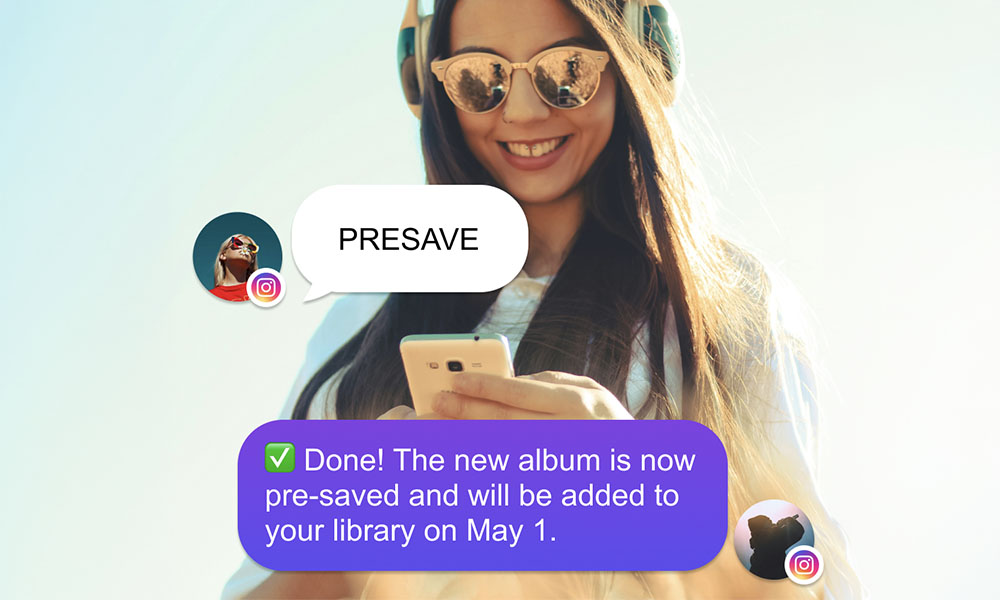
- The comment triggers a DM
- The DM delivers the pre-save link instantly
- The fan completes the action
This loop removes friction, preserves context, and aligns with the moment of intent.
It also reflects the broader framework introduced throughout this cluster:
- Comments act as entry points
- Messaging acts as the conversion layer
- The system connects interaction to action
When these elements are aligned, conversion becomes significantly more predictable.
Step 1: Designing Posts That Generate Actionable Comments
Not all comments are useful for conversion.
A post that generates generic reactions may perform well in terms of engagement but does not create a clear pathway to action.
The goal is to generate comments that can be used as triggers.
This requires intentional prompts.
Effective prompts typically:
- Ask for a specific response
- Use a simple keyword or phrase
- Offer a clear reason to participate
For example, instead of posting a teaser with no direction, you might ask fans to comment a word to receive something in return.
This transforms the comment from a reaction into a deliberate action.
It also prepares the fan for the next step.
Step 2: Connecting Comments to Instant DM Responses
Once the comment is captured, the response must be immediate.
Timing is critical because intent decays quickly.
If a fan comments and receives a message seconds later, the connection feels natural. If the response is delayed, the moment is lost.
The DM should:
- Reference the fan’s action
- Deliver the promised value
- Provide a clear next step
In most cases, that next step is the pre-save link.
This is where the traditional gap between engagement and conversion is closed.
Instead of asking the fan to find the link, it is delivered directly to them.
Step 3: Structuring the Pre-Save Experience
The DM is not just a delivery mechanism. It is part of the experience.
A well-structured message does more than drop a link.
It provides context.
For example, it may:
- Reinforce why the release matters
- Highlight what the fan will get
- Create a sense of urgency
This increases the likelihood that the fan will follow through.
It also ensures that the pre-save action feels connected to the interaction that triggered it.
Step 4: Adding Follow-Up to Capture Missed Conversions
Not every fan will complete the pre-save immediately.
Some will open the message but not act. Others may intend to return later.
Follow-up messages allow you to recover these missed opportunities.
Effective follow-ups:
- Remind fans about the release
- Reintroduce the pre-save link
- Add urgency as the release approaches
The key is continuity.
The conversation should feel like a natural extension of the initial interaction, not a separate campaign.
Step 5: Extending the System Beyond a Single Campaign
The real value of this approach is not just in a single release.
It is in the system it creates.
Each comment that triggers a DM represents:
- A fan who engaged with your content
- A data point tied to a specific campaign
- An opportunity for future interaction
When these interactions are captured and connected, they form the foundation of a fan relationship system.
This allows you to:
- Re-engage fans across future releases
- Segment audiences based on behavior
- Build more targeted and efficient campaigns
Over time, this turns a series of isolated campaigns into a continuous growth engine.
Why This Approach Outperforms Link-in-Bio Strategies
The traditional link-in-bio model relies on delayed action.
It assumes that fans will leave the content, navigate to a profile, and complete a process.
In contrast, the comment-to-DM system operates in real time.
| Aspect | Link-in-Bio Approach | Comment-to-DM System |
|---|---|---|
| Timing | Delayed | Immediate |
| Friction | High | Low |
| Context | Lost | Preserved |
| Conversion rate | Lower | Higher |
| Data capture | Limited | Strong |
The difference is not just convenience.
It is alignment.
The system meets the fan at the moment of intent rather than expecting the fan to return later.
Common Mistakes That Reduce Conversion
Even with the right structure, execution matters.
A few common issues can limit results:
- Prompts that are unclear or too broad
- Delayed or inconsistent DM responses
- Messages that include too many steps or links
- Lack of follow-up for unconverted fans
- Treating each campaign as isolated rather than connected
Each of these breaks the conversion loop.
The effectiveness of the system depends on maintaining a clear, immediate pathway from comment to action.
Reframing Comments as a Conversion Channel
The most important shift is conceptual.
Comments are not just engagement metrics.
They are one of the most direct ways to capture intent on Instagram.
When used correctly, they become:
- Entry points into a campaign
- Triggers for messaging
- Drivers of measurable outcomes
This reframing changes how content is designed, how campaigns are structured, and how success is measured.
Conclusion: Turning Interaction Into Outcome
The challenge in music marketing is not generating attention.
It is converting that attention into action.
Instagram comments represent one of the most reliable signals of intent. But without a system to capture and direct that intent, their value is lost.
By connecting comments to immediate DM responses and structuring the experience around that interaction, artists can transform engagement into pre-saves in a predictable and scalable way.
This is not a minor optimization.
It is a shift from passive promotion to active conversion.
And for modern release strategies, that shift defines the difference between visibility and growth.