How Artists Use Instagram DMs to Promote a New Release
Most release campaigns still rely on a familiar pattern.
Artists post teasers. They build anticipation. They remind fans to click a pre-save link in bio. On release day, they post again and hope momentum carries forward.
The structure is simple. It is also increasingly ineffective.
The gap between attention and action has widened. Fans engage with content, but very few follow through on the steps required to convert that interest into meaningful behavior.
Instagram DMs are changing how that gap is handled.
Instead of relying on fans to navigate toward conversion, artists are bringing the conversion point directly into the interaction itself.
This is not just a tactical improvement. It is a shift in how release campaigns are designed.
From Promotion to Guided Interaction
In earlier articles, we established that engagement alone does not produce outcomes. Comments, likes, and views signal interest, but they do not create movement unless they are connected to a system.
Instagram DMs provide that connection.
They act as the response layer to engagement.
A fan interacts with content.
That interaction triggers a message.
The message delivers the next step.
This transforms promotion into guided interaction.
Instead of broadcasting content and hoping for action, artists create structured pathways that move fans from attention to conversion in real time.
Where DMs Fit in a Release Strategy
To understand how artists use DMs effectively, it helps to place them within the broader release strategy framework.
A modern campaign typically moves through four phases:
- Early tease
- Pre-save push
- Release day activation
- Post-release retention
DMs operate across all four phases, but their role evolves at each stage.
Early Tease: Identifying Engaged Fans
At the beginning of a campaign, the goal is not immediate conversion. It is identifying who is paying attention.
Artists use content designed to trigger interaction:
- Teasers that invite comments
- Story prompts that encourage replies
- Simple calls to action that initiate DMs
When fans engage, they can receive a message that:
- Thanks them for engaging
- Offers early access or previews
- Signals that something is coming
At this stage, DMs function as a way to capture intent and begin a relationship.
Pre-Save Push: Converting Interest into Action
This is where DM marketing becomes central.
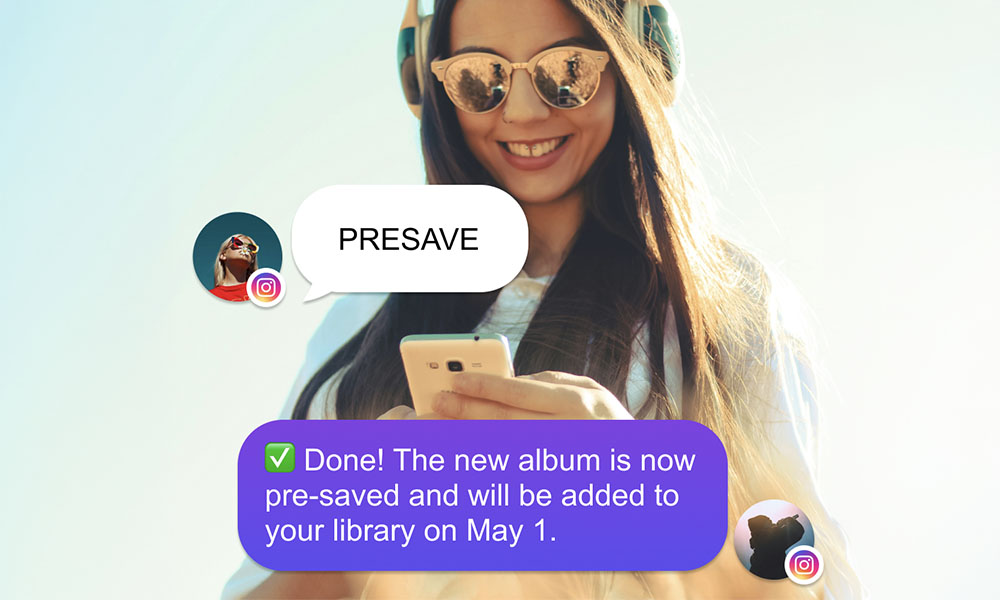
Instead of relying on passive link clicks, artists use interaction triggers to deliver pre-save links directly to fans.
A typical flow looks like this:
- A fan comments on a teaser post
- That comment triggers a DM
- The DM delivers the pre-save link instantly
- The fan completes the action while interest is still high
This structure aligns with what we previously defined as a trigger-based system.
The key advantage is timing.
The pre-save link is delivered at the exact moment the fan expresses interest. There is no delay, no need to search for a link, and no loss of context.
This significantly increases completion rates compared to traditional link-in-bio approaches.
Release Day: Activating High-Intent Fans
By the time release day arrives, the artist has already identified a segment of highly engaged fans.
These are the fans who:
- Commented on posts
- Replied to stories
- Entered DM flows during the pre-release phase
DMs allow artists to activate this segment immediately.
Instead of posting and waiting for visibility, they can:
- Send streaming links directly
- Notify fans the moment the release goes live
- Share exclusive content tied to the release
Because these fans have already interacted, they are more likely to act.
This creates a more controlled and predictable release day outcome.
Post-Release: Extending the Campaign Lifecycle
Most campaigns lose momentum after release day.
DMs allow artists to extend that lifecycle.
Fans who engaged earlier can receive:
- Behind-the-scenes content
- Merch or tour announcements
- Follow-up messages that reinforce the release
This turns a single moment into an ongoing interaction.
Over time, these interactions build a persistent relationship rather than a one-time conversion.
Designing a High-Performing DM Flow
Effective DM campaigns are not about sending messages at scale. They are about designing sequences that feel natural and aligned with fan behavior.
A high-performing DM flow typically includes four components:
1. A Clear Trigger
The entry point must be intentional.
This is often a comment prompt or story reply that feels native to Instagram behavior.
The trigger should be simple and easy to act on.
2. Immediate Response
Timing is critical.
The message should arrive instantly after the trigger occurs.
This preserves the connection between action and response, which is essential for maintaining intent.
3. Focused Value Delivery
The message should deliver a single, clear next step.
For example:
- A pre-save link
- A preview or exclusive clip
- A signup opportunity
Overloading the message with multiple options reduces effectiveness.
4. Follow-Up Continuity
Not every fan will act immediately.
Follow-ups allow you to:
- Reinforce the action
- Add context or urgency
- Maintain the conversation
This is where DM marketing begins to resemble a system rather than a one-off interaction.
Why DMs Convert Better Than Traditional Promotion
The effectiveness of DMs comes down to three structural advantages.
1. Proximity to Intent
DMs are triggered by interaction.
This means they occur at the moment a fan is already engaged, not after the fact.
2. Reduced Friction
The path from interest to action is shortened.
Fans do not need to navigate away from content or search for links.
3. Direct Delivery
Messages are delivered directly to the user.
They are not subject to the same algorithmic limitations as feed posts.
These advantages combine to create a more efficient conversion pathway.
Instead of relying on volume, DM-based campaigns rely on alignment between timing, context, and action.
From Campaign Tactics to Marketing Infrastructure
One of the most important ideas introduced in this cluster is that individual tactics become significantly more powerful when they are part of a system.
DMs are a clear example of this.
On their own, they are a communication tool.
When integrated into a campaign engine, they become infrastructure.
They connect:
- Content interactions
- Conversion actions
- Fan data
- Ongoing communication
Each interaction feeds into the next.
A fan who engages during one release can be re-engaged during the next. Over time, this creates a compounding effect.
This is what allows artists to move from isolated campaigns to sustained audience growth.
Common Mistakes Artists Make with DM Campaigns
Despite the advantages, many DM campaigns underperform due to avoidable issues.
Some of the most common include:
- Treating DMs as broadcast messages rather than responses to interaction
- Delivering messages too late after the trigger occurs
- Including too many links or unclear instructions
- Failing to follow up with engaged fans
- Not capturing or using interaction data across campaigns
Each of these issues breaks the connection between engagement and conversion.
The effectiveness of DMs depends on maintaining that connection.
Reframing the Role of Instagram in a Release Campaign
When DMs are used effectively, Instagram changes role.
It is no longer just a place to promote content.
It becomes a system for initiating and guiding fan behavior.
Content generates interaction.
Interaction triggers messaging.
Messaging drives conversion.
This creates a closed loop where attention is captured and directed rather than lost.
Conclusion: Turning Attention into Action
The challenge in modern music marketing is not generating attention.
It is knowing what to do with it.
Instagram DMs provide a way to capture that attention and convert it into meaningful outcomes, from pre-saves to long-term fan relationships.
But their effectiveness depends on structure.
When used as part of a trigger-based system within a broader release strategy, DMs transform from a messaging tool into a core component of marketing infrastructure.
And for artists navigating increasingly competitive platforms, that distinction is what determines whether engagement remains surface-level or becomes growth.