How Artists Use Instagram Stories to Start Fan Conversations
Most artists treat Instagram Stories as a secondary channel.
A place for casual updates. Behind-the-scenes clips. Quick reposts that disappear in 24 hours.
But this framing misses what Stories actually are.
Stories are not just temporary content. They are interaction environments.
Unlike the feed, which is optimized for passive consumption, Stories are designed for participation. Polls, sliders, questions, and taps are built directly into the experience.
This makes Stories one of the most effective entry points into the conversation layer of a release campaign.
And in a DM-driven marketing system, conversation is where outcomes happen.
Pre-saves. Link clicks. Fan identification. Relationship building.
The role of Stories, then, is not just to keep fans updated. It is to move them into interaction pathways that lead to direct messages.
Why Stories Are Naturally Built for Conversation
Every Instagram surface shapes behavior.
The feed encourages scrolling. Reels encourage discovery. Stories encourage interaction.
This is not accidental.
Stories are structured around low-friction actions:
- Tap to vote
- Tap to react
- Tap to respond
Each of these actions reduces the psychological barrier to participation.
A fan who might hesitate to comment on a post will often respond to a Story.
This makes Stories uniquely valuable in a release strategy.
They allow you to warm up interaction behavior before asking for higher-intent actions like commenting or clicking a pre-save link.
In other words, Stories help transition fans from passive observers into active participants.
The Role of Stories in the Interaction Pathway
In a structured Instagram release campaign, each format serves a specific role.
- Feed posts create visibility and initiate interaction
- Comments trigger entry into DMs
- DMs guide conversion
Stories operate earlier in the pathway.
They are designed to:
- Introduce low-effort participation
- Build familiarity with interaction
- Prepare fans for deeper engagement
This is why Stories are often most effective when used before or alongside comment-driven campaigns.
They reduce friction before the main conversion moments.
Turning Story Interactions Into Conversations
The most common mistake with Stories is stopping at the interaction.
A poll gets responses. A question sticker gets answers. And then the interaction ends.
But the real opportunity begins after the response.
Every Story interaction is a signal of intent. It is a fan raising their hand.
That signal can be used to initiate a DM and extend the interaction.
The structure looks like this:
- Story interaction (poll, question, etc.)
- Triggered or manual DM
- Guided follow-up interaction
For example:
- A fan votes “yes” on a poll about an upcoming track
- They receive a DM with a teaser or pre-save link
- The conversation continues
This transforms Stories from engagement tools into conversation gateways.
The Most Effective Story Formats for Driving DMs
Not all Story interactions lead naturally into conversation.
The most effective formats are those that create a clear transition point between interaction and response.
1. Polls That Segment Interest
Polls are one of the simplest and most effective tools.
They allow you to quickly identify fan intent.
For example:
- “Want early access to the new track?”
- Yes
- Of course
Fans who select a positive response can then be followed up with a DM.
This creates a clean pathway:
Poll → Interest signal → DM → Action
From a marketing perspective, this is both engagement and segmentation.
2. Question Stickers That Invite Direct Input
Question stickers create open-ended interaction.
They feel more personal, which increases response quality.
For example:
- “What do you think this song is about?”
- “What should I drop next?”
Each response creates an opportunity to reply directly via DM.
This turns a single Story into multiple one-to-one conversations.
3. “DM Me” Prompts Embedded in Stories
Sometimes the simplest approach is the most effective.
A Story can directly instruct fans to message.
For example:
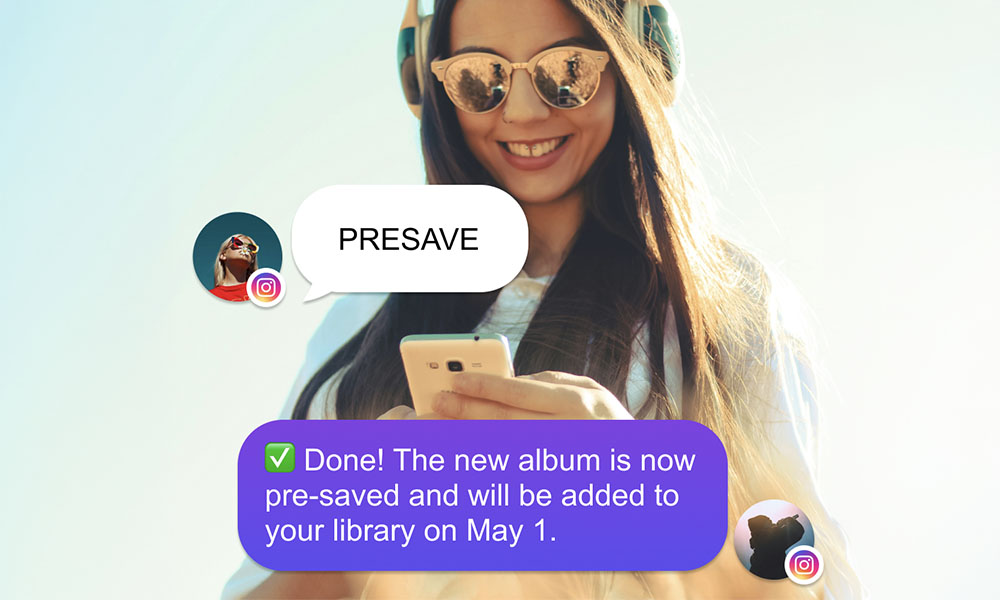
- “DM me ‘PRESAVE’ and I’ll send the link”
- “Message me if you want the track early”
Because Stories feel more immediate and personal, these prompts often perform better than similar calls-to-action in feed posts.
4. Sequential Stories That Build Toward Interaction
A single Story can drive interaction. A sequence can amplify it.
For example:
- Introduce a teaser
- Add context or narrative
- Present an interaction prompt
This progression increases engagement because it builds momentum.
By the time the interaction appears, the fan is already invested.
Using Stories to Support Pre-Save Campaigns
Stories are particularly effective in pre-release strategy because they allow you to introduce the pre-save concept gradually.
Instead of immediately asking for action, you can:
- Build curiosity around the release
- Introduce the idea of saving the track
- Transition into a DM-driven pre-save flow
For example:
- Story 1: Teaser clip
- Story 2: Poll (“Should I drop this soon?”)
- Story 3: “Want early access? DM me”
This sequence aligns with how fans naturally engage.
It moves from awareness to interaction to conversation without forcing a jump.
Stories as a Reinforcement Layer
Stories are not just entry points. They are also reinforcement tools.
During a release campaign, they can be used to:
- Remind fans about comment triggers
- Reintroduce pre-save opportunities
- Highlight fan participation
For example:
- Reposting comments from a feed post
- Showing fans who already pre-saved
- Adding urgency as release day approaches
This keeps the interaction pathway visible without relying on new feed posts.
The Compounding Effect of Story-Driven Conversations
Each Story interaction may seem small.
A poll response. A quick reply. A short DM exchange.
But these interactions accumulate.
Over time, they create:
- Familiarity with engagement patterns
- Comfort with messaging
- Stronger artist-fan relationships
This is what allows later campaign stages to perform better.
When a fan sees a comment trigger or a pre-save prompt, they are not encountering it for the first time.
They have already interacted. They have already participated.
The barrier is lower.
This is the compounding effect of interaction-first marketing.
From Temporary Content to Persistent Systems
Stories disappear. Conversations do not.
This is the key distinction.
While the content itself is temporary, the interactions it creates are persistent.
Each DM becomes part of a broader system:
- A record of engagement
- A point of future contact
- A signal for segmentation
This is how Stories contribute to a larger fan relationship system.
They initiate interactions that can be extended, tracked, and built upon over time.
A Different Way to Think About Stories
Most artists think of Stories as supplemental content.
In a modern release strategy, they are foundational.
They provide the lowest-friction entry point into interaction. They prepare fans for deeper engagement. They support and reinforce conversion pathways.
Most importantly, they align with how fans naturally behave.
They do not ask for large commitments. They invite small actions.
And those small actions, when structured correctly, lead to meaningful outcomes.
Pre-saves. Conversations. Long-term engagement.
Not because the content was more visible.
But because it was designed to move the fan forward.