How Instagram Messaging Is Changing the Way Artists Promote Music
For most of the past decade, Instagram has functioned as a broadcast channel.
Artists posted content. Fans consumed it. Engagement was measured in likes, comments, and views. Success was defined by reach.
But the mechanics of promotion have shifted.
What used to be a one-to-many system is becoming a network of one-to-one interactions. Messaging is no longer a secondary feature of the platform. It is quickly becoming the primary layer where meaningful fan interaction happens.
This shift is not just behavioral. It is structural.
It changes how attention is captured, how intent is handled, and how release strategies are designed.
The Evolution from Broadcast to Conversation
Traditional Instagram strategy is built around distribution.
The goal is to maximize visibility. Content is optimized for reach, shareability, and algorithmic performance. The assumption is that exposure leads to growth.
But exposure alone does not create outcomes.
As we established earlier in this cluster, engagement does not equal conversion. Likes and comments signal interest, but they do not inherently lead to actions like pre-saves or follows.
Messaging introduces a different model.
Instead of broadcasting content and hoping for downstream action, messaging allows artists to respond directly to fan interactions in real time. It creates a continuous loop between content, interaction, and conversion.
This transforms Instagram from a discovery surface into an interaction system.
Messaging as a Conversion Layer
To understand the impact of messaging, it helps to separate two layers of the platform:
- The content layer, where posts, reels, and stories generate attention
- The messaging layer, where conversations and actions take place
Most artists operate almost entirely within the content layer.
They focus on posting frequency, visual quality, and engagement metrics. Conversion is treated as a secondary step, usually handled through a link in bio.
Messaging collapses that separation.
When a fan interacts with content, whether by commenting, replying to a story, or sending a DM, that interaction can immediately trigger a response that delivers the next step.
This is what we previously defined as a trigger-based system.
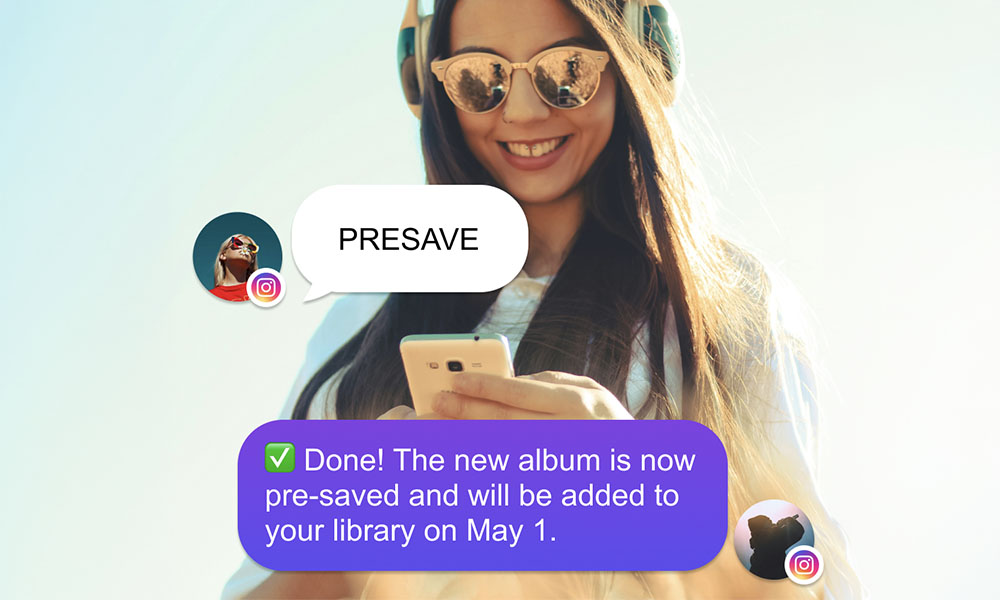
A fan comments.
That comment triggers a DM.
The DM delivers a pre-save link or call to action.
The conversion layer is no longer separate. It is embedded directly within the interaction.
Why Messaging Aligns with Platform Behavior
Instagram’s design increasingly prioritizes private and semi-private interaction.
Users spend more time in:
- Direct messages
- Story replies
- Close friends content
- Small-group interactions
Public engagement, such as likes and feed comments, still matters, but it is no longer the only or even primary form of interaction.
Messaging aligns with how users naturally behave on the platform.
It feels:
- More personal
- More immediate
- Less performative
This has two important implications for music marketing.
First, fans are more likely to respond in messaging environments. The barrier to interaction is lower, and the experience feels conversational.
Second, messaging allows for controlled communication. Unlike feed posts, which compete with the algorithm, messages are delivered directly to the user.
This makes messaging a more reliable channel for driving action.
Rebuilding the Release Strategy Around Interaction
When messaging becomes central, the structure of a release strategy changes.
Instead of optimizing for reach and hoping for conversion, campaigns are designed around interaction pathways.
In earlier articles, we introduced the concept of trigger-based entry points and immediate response mechanisms. Messaging is the layer that makes those systems possible.
A modern release strategy built around messaging typically follows this pattern:
1. Content Designed to Trigger Interaction
Posts and stories are structured to encourage specific actions:
- Commenting a keyword
- Replying to a story
- Sending a message
These actions are not incidental. They are intentional entry points into the campaign.
2. Automated or Structured Message Responses
When a trigger occurs, the system responds instantly.
The message delivers:
- A pre-save link
- Exclusive content
- A signup opportunity
This ensures that intent is captured at the moment it occurs.
3. Ongoing Conversation and Follow-Up
Messaging allows for continuity.
Fans who engage can receive:
- Reminders leading up to release day
- Updates when the music drops
- Additional content after release
This creates a multi-step interaction rather than a single touchpoint.
The Impact on Pre-Save Campaigns
Pre-save campaigns are one of the clearest examples of how messaging changes outcomes.
Traditionally, pre-save campaigns rely on passive behavior. Fans are asked to click a link, often from a bio, and complete a process outside the platform.
This introduces friction and reduces conversion.
Messaging removes that friction.
When a fan engages with content, the pre-save link can be delivered instantly through a DM. The action becomes immediate and contextual.
This has several effects:
- Higher completion rates due to reduced steps
- Stronger alignment between interest and action
- Better tracking of which interactions drive conversions
More importantly, it changes how pre-save campaigns are positioned.
Instead of asking fans to take initiative, the system guides them through the process.
Messaging as Infrastructure, Not Just a Feature
One of the most important shifts is how messaging is conceptualized.
It is easy to view messaging as a feature. A tool for sending replies or automating responses.
But in a modern marketing system, messaging functions as infrastructure.
It connects:
- Content interactions
- Conversion actions
- Fan data
- Ongoing communication
Every message is part of a larger system.
A fan who receives a pre-save link via DM is not just completing a single action. They are entering a structured relationship pathway.
That pathway can extend across:
- Multiple campaigns
- Different release cycles
- Additional channels such as SMS or email
Over time, messaging becomes the connective layer that ties all of these interactions together.
Comparing Messaging to Traditional Promotion Models
To understand the magnitude of this shift, it helps to compare messaging-driven promotion with traditional approaches.
| Aspect | Traditional Social Promotion | Messaging-Driven Promotion |
|---|---|---|
| Communication style | One-to-many | One-to-one |
| Conversion path | Indirect | Direct |
| Timing | Delayed | Immediate |
| Data capture | Limited | High |
| Continuity | Fragmented | Persistent |
Traditional models rely on volume.
Messaging-driven models rely on structure.
They do not necessarily require more content or more reach. They require better systems for handling interaction.
The Role of Comments in Messaging Systems
As discussed in previous articles, comments serve as one of the most effective entry points into messaging flows.
They represent active engagement and can be used as triggers.
When integrated with messaging, comments become:
- A signal of interest
- A trigger for action
- A data point for future targeting
This reinforces the idea that engagement should not be treated as an endpoint.
It is the beginning of a process.
Messaging is what allows that process to continue.
Common Misconceptions About Instagram Messaging
Despite its growing importance, messaging is often misunderstood.
A few assumptions tend to limit its effectiveness:
- It is only for fan communication
In reality, it is a primary conversion channel. - It cannot scale
With the right systems, messaging can operate across large audiences through structured automation. - It replaces content strategy
Messaging complements content. It does not replace it. - It is intrusive
When triggered by user actions, messaging feels contextual rather than disruptive.
The key is alignment.
When messaging is tied to fan behavior, it enhances the experience rather than interrupting it.
The Future of Artist-Fan Interaction
The broader trend is clear.
Social platforms are moving toward more private, direct forms of interaction. At the same time, artists are seeking more control over their audience relationships.
Messaging sits at the intersection of these trends.
It allows artists to:
- Capture intent in real time
- Guide fans toward meaningful actions
- Build ongoing communication channels
Over time, this reduces reliance on algorithms and increases control over audience growth.
Reframing Promotion as System Design
The most important shift is not tactical. It is conceptual.
Promotion is no longer just about content creation.
It is about system design.
Every post, story, and interaction should be part of a larger framework that:
- Captures attention
- Converts interest
- Builds relationships
Messaging is the layer that connects these steps.
It turns isolated interactions into continuous pathways.
And for artists building sustainable careers, that distinction is critical.
Conclusion: Messaging Is Reshaping the Marketing Stack
Instagram messaging is not a trend or a temporary tactic.
It represents a structural change in how platforms function and how fans interact.
Artists who adapt to this shift will not just see better campaign performance. They will build more resilient marketing systems.
Because the future of music promotion is not just about being seen.
It is about knowing what happens next.