The Instagram Release Campaign Playbook for Independent Artists
Most release campaigns fail for a simple reason.
They are built around moments, not systems.
A teaser post. An announcement. A pre-save link. A release day push.
Each piece exists, but they are loosely connected. There is no clear pathway guiding a fan from first exposure to final action.
The result is predictable. Strong engagement at the top. Weak conversion at the bottom.
This is not a content problem. It is a structural one.
The most effective Instagram release campaigns are not collections of posts. They are designed behavioral pathways. Every piece of content has a role. Every interaction moves the fan forward.
The goal is not just to promote a release. It is to orchestrate fan movement from awareness to action.
This playbook outlines how that system works.
The Core Principle: Design for Movement, Not Visibility
Traditional music marketing treats Instagram as a distribution channel.
You publish content. The algorithm distributes it. Fans react.
In this model, success is measured by reach and engagement.
But engagement alone does not produce outcomes. It only signals attention.
A release campaign built for movement asks a different question:
What should the fan do next?
Every post, story, and interaction is designed to answer that question.
The pathway typically looks like this:
- Awareness
- Interaction
- Conversation
- Conversion
Each stage builds on the previous one. Each reduces friction. Each increases intent.
The feed introduces the release. The interaction creates participation. The DM establishes continuity. The conversion completes the action.
When this pathway is intentional, Instagram becomes more than a content platform. It becomes a conversion engine embedded within your release strategy.
Phase 1: Pre-Release Positioning (Before the Announcement)
Before you announce a project, you need context.
Fans do not engage deeply with something they do not understand.
This phase is not about revealing the release. It is about preparing the audience to care.
Effective pre-release positioning often includes:
- Visual world-building
- Subtle references to the project
- Behind-the-scenes content
- Emotional or narrative framing
The objective is to create familiarity.
By the time the official announcement arrives, the project should feel recognizable, not new.
From a behavioral standpoint, this reduces resistance. Fans are more likely to engage when they feel included in the process.
Phase 2: The Announcement as an Entry Point
The announcement is not just a reveal. It is the most important interaction trigger in the campaign.
This is where most campaigns break.
They announce the release and link out. They inform, but they do not guide.
A high-performing announcement does three things simultaneously:
- Introduces the release clearly
- Creates a reason to act
- Defines a simple next step
In a DM-driven system, that next step is typically a comment trigger:
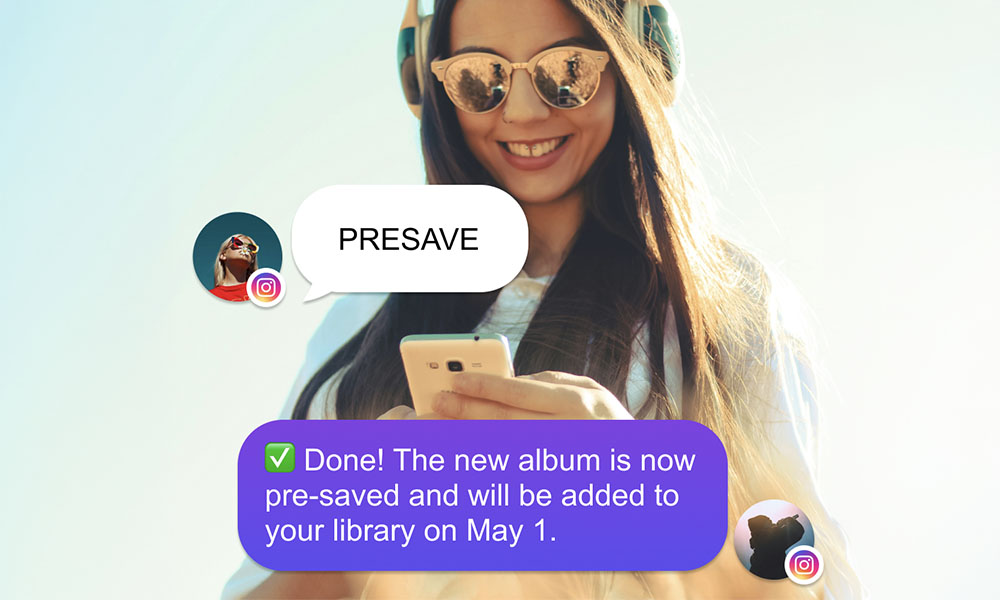
“Comment ‘ALBUM’ and I’ll send you the pre-save link.”
This transforms the announcement from a passive moment into an active entry point.
The fan does not just see the release. They participate in it.
That participation initiates a DM, where the conversion can be guided directly.
Phase 3: Conversation as the Conversion Layer
The most important shift in modern Instagram marketing is where conversion happens.
Not in the bio. Not on an external landing page.
Inside the DM.
A DM is a controlled environment. It removes distractions. It creates continuity. It allows for structured interaction.
This is where pre-saves, link clicks, and deeper engagement occur.
An effective DM flow is not a single message. It is a short sequence:
- Acknowledge the interaction
- Deliver the pre-save link
- Reinforce the value of the action
- Continue the conversation
For example:
- “Appreciate you commenting. Here’s the pre-save link.”
- “It’ll automatically add the album to your library on release.”
- “Let me know what you think of the snippet I posted.”
This structure increases both completion rates and engagement quality.
It transforms the pre-save from a task into an experience.
Phase 4: Reinforcement Through Repetition
One post is not enough.
Even the best-performing announcement will only reach a portion of your audience.
Reinforcement ensures that the interaction pathway remains visible throughout the campaign.
This includes:
- Additional posts with similar comment triggers
- Story reminders and follow-ups
- Variations of the same call-to-action
The key is consistency.
When fans repeatedly see the same interaction pattern, participation increases. The behavior becomes familiar.
This is not redundancy. It is behavioral conditioning.
Phase 5: Escalation as Release Day Approaches
As the release date gets closer, urgency becomes more important.
Fans who have not yet engaged need a stronger reason to act.
This phase introduces time-based incentives:
- “Dropping in 48 hours. Last chance to pre-save.”
- “Release is tomorrow. I’m sending the link to everyone who comments.”
The structure remains the same, but the messaging shifts.
Instead of curiosity, the driver becomes immediacy.
This phase captures late engagement and converts passive awareness into action.
Phase 6: Release Day as a Continuation, Not a Peak
Most artists treat release day as the end of the campaign.
In a DM-driven system, it is a transition point.
By release day, you have already:
- Built awareness
- Initiated conversations
- Collected high-intent interactions
Now, the focus shifts to activation.
DMs can be used to:
- Notify fans that the release is live
- Share streaming links
- Encourage immediate listening
Because these fans have already engaged, the response rate is significantly higher.
Release day becomes more efficient because the groundwork has already been done.
Phase 7: Post-Release Momentum
The campaign does not end when the music is live.
Post-release is where long-term engagement is built.
This phase often includes:
- Fan feedback loops
- Additional content drops
- Continued DM interaction
Fans who engaged during the campaign can be reactivated:
- “Have you listened yet?”
- “Which track is your favorite?”
This maintains continuity and extends the lifecycle of the release.
The Role of Content Within the System
Content still matters.
But its role has changed.
It is no longer the endpoint. It is the entry mechanism.
Each post should be evaluated not just by how it performs, but by what it initiates.
Does it:
- Start a conversation?
- Create a reason to interact?
- Move the fan into a DM?
If not, it may generate engagement, but it will not drive outcomes.
Why This Playbook Works
This approach works because it aligns with how fans actually behave.
Fans do not follow linear funnels. They move through interactions.
Each interaction increases familiarity. Each step reduces friction.
By the time a fan reaches a pre-save link, the decision is already made.
The link is just the final step.
This is why DM-driven campaigns consistently outperform traditional pre-save strategies.
They do not rely on a single moment of action. They build toward it.
From Campaigns to Systems
The most important takeaway from this playbook is not any individual tactic.
It is the shift in perspective.
A release campaign is not a series of posts.
It is a system for guiding fan behavior.
When that system is intentional:
- Engagement becomes interaction
- Interaction becomes conversation
- Conversation becomes conversion
And over time, each campaign becomes more effective than the last.
Because you are not starting from zero.
You are building on existing relationships, existing data, and existing pathways.
This is what separates short-term promotion from long-term growth.
Not just reaching fans, but moving them.