Why Instagram Comments Are One of the Most Underrated Music Marketing Channels
Most artists treat Instagram comments as a signal.
A post gets 50 comments, 200 comments, 1,000 comments. That number becomes a proxy for engagement, relevance, or momentum.
But comments are not just a signal. They are an entry point.
In modern music marketing, the comment section is one of the few places where fans actively choose to participate. That action carries intent. It reflects curiosity, interest, or emotional investment in a moment.
And yet, most campaigns stop there.
They measure comments. They celebrate comments. But they do not capture or convert them.
This is where a major opportunity exists.
The Hidden Value of a Comment
A comment is one of the highest-intent actions a fan can take on Instagram.
It requires more effort than a like. It is more deliberate than a passive view. It often happens at the peak of attention, when a fan is reacting to a piece of content in real time.
From a marketing perspective, that moment matters.
When a fan comments, three things are true:
- They are currently engaged with your content
- They are still inside the Instagram environment
- They are receptive to a response
That combination rarely exists in other parts of the funnel.
A user who clicks a link in bio has already left the context. A user who watches a story may never take action. But a commenter is still present, still engaged, and still reachable.
This is why comments should not be treated as an outcome. They should be treated as a trigger.
From Engagement Signal to Conversion Trigger
The shift from passive engagement to active conversion is the foundation of modern release strategy.
Traditionally, Instagram campaigns rely on a sequence that looks like this:
- Post content
- Generate engagement
- Direct users to a pre-save link in bio
- Hope they follow through
The problem is that engagement and conversion are disconnected.
Comments live on the post. Pre-save links live somewhere else. The user must bridge that gap manually.
Most do not.
When comments are treated as triggers instead of signals, the structure changes:
- Post content designed to encourage interaction
- Fan comments on the post
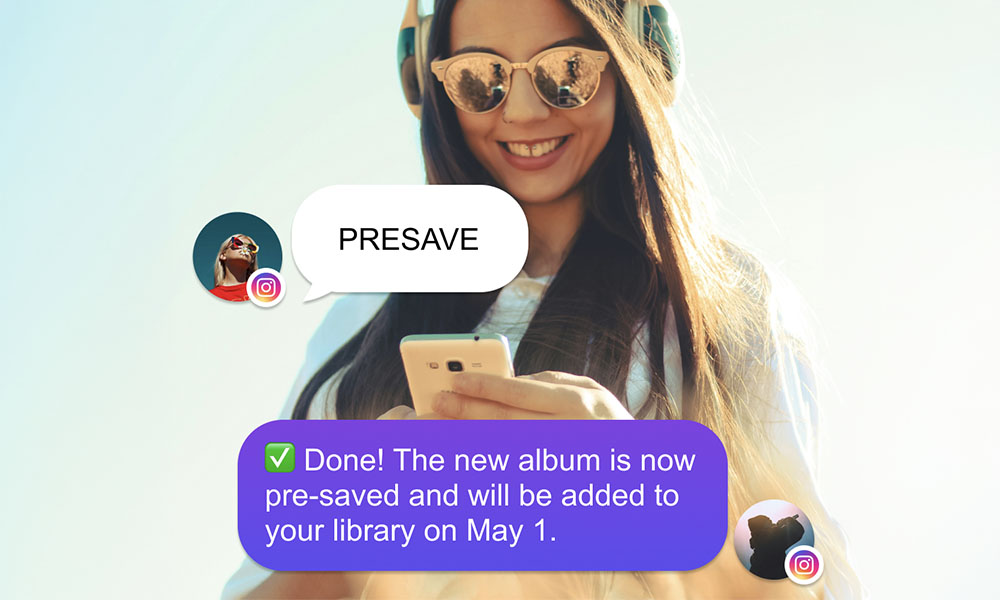
- Comment triggers a direct message
- The DM delivers the pre-save link instantly
This creates a closed loop.
The fan expresses interest. The system responds immediately. The next step is delivered without friction.
In this model, comments become the entry point into a conversion flow rather than the end of an engagement cycle.
Why Comments Outperform Link-in-Bio for Pre-Saves
The link-in-bio model assumes that fans will take multiple steps after seeing your content.
They need to:
- Leave the post
- Navigate to your profile
- Click the link
- Choose the correct destination
- Complete the action
Each step introduces drop-off.
Comments remove most of that friction.
When a fan comments and receives a direct message with a pre-save link, the path becomes immediate and contextual. The action is tied directly to the moment of interest.
This has several practical advantages:
- Higher conversion rates because the action is delivered at peak intent
- Reduced cognitive load since the fan does not need to search for the next step
- Stronger attribution because each comment can be tied to a specific campaign
In effect, comments allow you to collapse the funnel.
Instead of guiding users across multiple surfaces, you bring the conversion point directly to them.
Designing Content That Generates Actionable Comments
Not all comments are equally valuable.
A post that generates generic reactions may perform well in terms of engagement, but it does not necessarily create useful entry points for a campaign.
The goal is not just to increase comment volume. It is to generate comments that can be captured and converted.
This requires intentional design.
Content that drives actionable comments often includes:
- A clear prompt or call to action
- A simple keyword or phrase to respond with
- A reason for the fan to participate
For example, instead of posting a teaser with no direction, you might frame it as:
“Comment ‘early’ and I’ll send you the pre-save link”
This does two things simultaneously. It increases engagement, and it creates a structured trigger that can be used to initiate a DM flow.
The important distinction is that the comment is no longer incidental. It is part of the campaign design.
Integrating Comments into a Pre-Release Strategy
Comments are most powerful when they are embedded within a broader pre-release strategy.
In earlier frameworks, we established that a release campaign should move through distinct phases, from early tease to pre-save push to release day activation.
Comments can play a role at each stage.
Early Tease Phase
During the early phase, comments help identify engaged fans.
Prompts can focus on:
- Gauging interest
- Collecting reactions
- Encouraging participation
At this stage, the goal is not immediate conversion. It is building a pool of fans who are likely to engage again.
Pre-Save Push
This is where comments become a primary conversion mechanism.
Posts should be designed to:
- Encourage keyword-based comments
- Trigger automated DMs
- Deliver pre-save links instantly
The transition from engagement to action happens here.
Release Day
On release day, comments can be used to drive immediate listening behavior.
Fans who comment can receive:
- Streaming links
- Exclusive content
- Direct reminders
Because these fans have already interacted, they represent a high-intent segment.
Post-Release Retention
After release, comments can continue to fuel engagement loops.
They can trigger:
- Additional content drops
- Merch promotions
- Tour announcements
This extends the lifecycle of the campaign beyond the initial release window.
Comments as the Front Door of a Fan Relationship System
When viewed in isolation, comments appear temporary.
They exist on a post, tied to a moment, and then fade as new content replaces the old.
But when integrated into a broader system, comments become persistent signals.
Each comment represents:
- A fan who engaged with a specific piece of content
- A moment of interest tied to a campaign
- An opportunity to initiate a relationship
When these interactions are captured and connected to other data points, such as link clicks or pre-save completions, they begin to form a structured audience layer.
This is where the concept of marketing infrastructure becomes relevant.
Instead of running one-off campaigns, you begin building a system where:
- Engagement triggers actions
- Actions generate data
- Data informs future campaigns
Over time, this creates a feedback loop that improves efficiency and targeting.
Comments are simply the front door.
Common Mistakes in Comment-Based Campaigns
Despite their potential, many artists fail to extract meaningful value from comments.
The issue is rarely the volume of engagement. It is how that engagement is handled.
Several patterns tend to limit performance:
- No follow-through
Comments are generated but never converted into actions. - Unclear prompts
Fans are not given a reason or instruction to comment in a useful way. - Delayed responses
The gap between comment and response reduces effectiveness. - Overly generic messaging
Responses that feel automated without context reduce trust. - Lack of system integration
Comments are treated as isolated interactions rather than part of a broader strategy.
In each case, the underlying issue is the same. The comment is not connected to a larger flow.
The Strategic Shift: Designing for Interaction, Not Just Reach
The most important takeaway is not tactical. It is conceptual.
Traditional Instagram strategy focuses on maximizing reach.
Modern strategy focuses on maximizing interaction.
Reach creates visibility. Interaction creates opportunity.
When you design content with interaction in mind, you begin to think differently about posts:
- What action will this post trigger?
- How will that action be captured?
- What happens immediately after?
Comments become a deliberate mechanism rather than a byproduct.
And once that shift happens, the entire role of Instagram changes.
It becomes less about broadcasting content and more about initiating conversations that lead somewhere.
Reframing the Comment Section
The comment section is often treated as a passive layer beneath content.
In reality, it is one of the most active and intentional spaces on the platform.
It is where fans choose to engage.
It is where attention peaks.
And, when used correctly, it is where conversion begins.
For artists building a modern release strategy, this is not a minor optimization.
It is a structural advantage.
Because the artists who win are not just the ones who generate attention.
They are the ones who know what to do with it.

Keep reading
All posts
How to Evaluate Any Pre-Save Tool After Spotify's Latest API Change

5 Pre-Save Alternatives That Still Capture Fan Data (No Spotify Login Required)