How to Turn Instagram, SMS, and Links Into Spotify Growth Engines
Most artists treat marketing channels as distribution tools.
Instagram is for posting. SMS is for announcements. Links are for directing traffic.
Each channel operates independently, with its own metrics, its own content, and its own moment of engagement. The result is a fragmented system where attention is constantly reset and intent is rarely compounded.
This is why many release campaigns feel active but fail to produce sustained growth. The inputs are there. The coordination is not.
A more effective approach reframes these channels entirely. Instagram, SMS, and links are not just communication tools. When structured correctly, they become components of a unified growth engine that converts fan actions into Spotify signals.
The Core Problem: Disconnected Actions
In earlier articles in this cluster, we established that growth on Spotify is driven by coordinated signals of intent rather than isolated actions.
Saves, follows, and early listening behavior carry more weight when they occur together, especially within a short time window.
However, most campaigns distribute these actions across disconnected channels.
A fan might:
- see a post on Instagram
- click a link in bio
- forget to complete a pre-save
- never receive a follow-up
Each step exists, but there is no continuity between them.
The system fails to capture and extend the fan’s initial intent.
From Channels to Systems
To turn Instagram, SMS, and links into growth engines, they must be connected into a single system.
This system should do three things:
- capture fan intent at the moment it appears
- guide that intent into specific actions
- extend those actions into sequences that generate multiple signals
This is the foundation of a fan growth system.
Instead of thinking in terms of campaigns per channel, the focus shifts to how channels work together to create a continuous flow of engagement.
The Role of Each Channel in a Growth Engine
Each channel has distinct strengths. The goal is not to use them interchangeably, but to use them in coordination.
Instagram: High-Attention Entry Point
Instagram is where attention is captured.
It is the discovery layer of the system. Fans encounter content, develop interest, and decide whether to engage further.
However, Instagram is not designed for deep conversion. Links are limited. Actions are indirect. Algorithms control reach.
This makes Instagram ideal for initiating actions, but not for completing them.
SMS: Direct Conversion and Retention Layer
SMS operates differently.
It is direct, immediate, and persistent. Messages are delivered without algorithmic filtering, and response rates are significantly higher than most other channels.
This makes SMS an effective environment for:
- completing high-intent actions
- reinforcing engagement
- triggering release-day behavior
SMS turns passive interest into active participation.
Links: Structural Connectors
Links still play a role, but their function changes.
Instead of acting as endpoints, links become connectors within the system. They bridge channels and guide users into structured experiences.
For example, a link can direct a fan from Instagram into a landing page, or from SMS into a pre-save flow.
The key is that links should not operate in isolation. They should be embedded within sequences.
Designing the Cross-Channel Flow
The power of a growth engine comes from how these channels are sequenced.
A typical flow might look like this:
- A fan encounters a post on Instagram
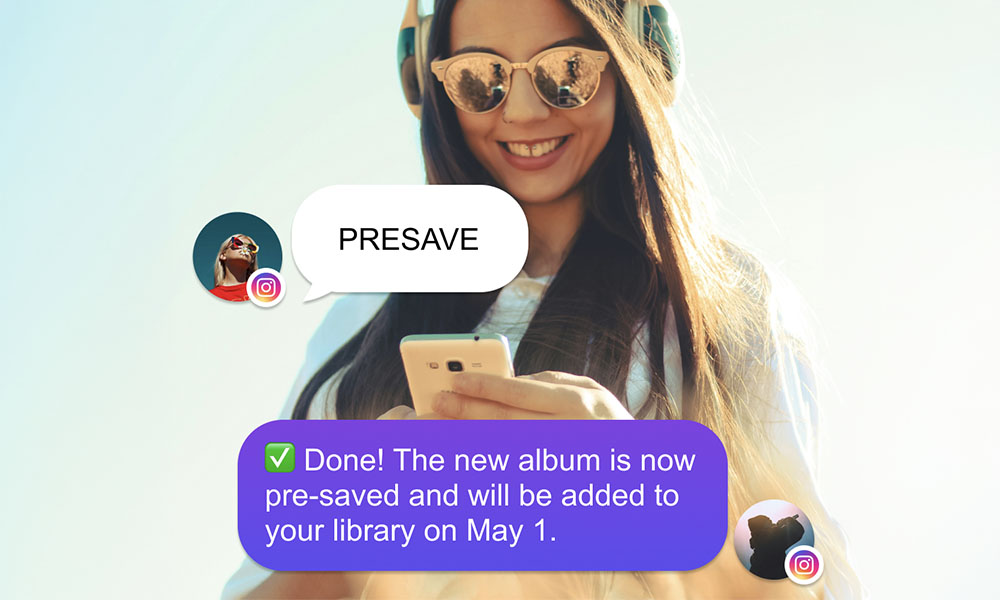
- The post prompts an action (comment, DM, or link click)
- The action triggers entry into a messaging flow
- The fan receives a pre-save prompt via SMS
- The system follows up with release-day notifications
- Post-release, the fan is prompted to save and follow
Each step builds on the previous one.
The initial interaction on Instagram is not the goal. It is the entry point.
The system captures that interaction and routes it into a structured sequence that produces multiple Spotify signals.
Why Messaging-Based Entry Points Outperform Links Alone
One of the most important shifts in this model is the use of messaging as the primary entry point.
When a fan sends a message or opts into SMS, they are taking a higher-intent action than simply clicking a link.
This has two effects:
- it filters for more engaged fans
- it creates a persistent communication channel
This allows the system to extend the interaction beyond a single moment.
For example, a fan who enters through SMS can receive:
- a pre-save prompt
- a reminder before release
- a notification on release day
- a follow-up sequence after release
Each message reinforces the original intent and increases the likelihood of generating multiple signals.
Coordinating Signals Across Channels
The ultimate goal is to generate clusters of signals rather than isolated actions.
This requires coordination.
A well-designed system ensures that:
- pre-saves happen before release
- listening behavior happens immediately after release
- saves and follows are prompted in context
These actions should not occur randomly. They should be sequenced deliberately.
For example, a fan who pre-saves via SMS can be automatically prompted to listen as soon as the track is live. After listening, they can be guided to save the track. Later, they can be encouraged to follow the artist.
This creates a chain of signals from a single entry point.
The Role of Action Flows in Cross-Channel Systems
Manually managing this level of coordination is impractical.
This is where Action Flows become essential.
An Action Flow connects events across channels and defines what should happen next.
For example:
- a comment on Instagram can trigger a DM
- the DM can prompt a text opt-in
- the text opt-in can trigger a pre-save flow
- the pre-save can trigger release-day messaging
Each step is automated, but contextually linked.
This allows the system to scale without losing cohesion.
Instead of managing campaigns channel by channel, you define the logic once and allow it to execute across your entire audience.
Eliminating Gaps in the Funnel
The biggest weakness in most campaigns is the gap between actions.
A fan takes one step, but there is no clear path to the next.
Cross-channel systems eliminate these gaps.
Every action should lead somewhere.
- a link click should lead to a defined action
- a pre-save should lead to a follow-up
- a release-day stream should lead to a save or follow
This continuity ensures that intent is not lost.
It also increases the efficiency of every interaction.
Measuring Cross-Channel Performance
Evaluating a growth engine requires a different set of metrics.
Channel-specific metrics, such as likes or click-through rates, provide limited insight.
More meaningful indicators include:
- the number of fans who complete multi-step sequences
- the average number of signals generated per fan
- the timing of actions relative to release
These metrics reflect how well the system converts and compounds intent.
They also align more closely with long-term growth on streaming platforms.
From Campaign Execution to Growth Infrastructure
The shift from channels to systems represents a broader change in how music marketing is approached.
Traditional campaigns are temporary. They are built for a single release and then reset.
Growth engines persist.
They capture fan relationships, store them, and activate them repeatedly over time.
Instagram, SMS, and links are not separate tools in this model. They are components of an integrated infrastructure.
This is what allows engagement to compound.
A fan acquired today becomes easier to activate tomorrow. A system built for one release becomes more effective with each subsequent release.
The Strategic Takeaway
The effectiveness of a release strategy is no longer determined by how many people you reach, but by how well you convert and coordinate fan intent.
Instagram captures attention. SMS converts and sustains engagement. Links connect the system.
When these channels are unified, they create a growth engine that produces multiple Spotify signals from a single interaction.
This is the foundation of modern music marketing.
Not more campaigns. Better systems.