The Complete Guide to Music Merch Marketing for Artists and Labels
Music merch marketing is the process of promoting an artist’s physical or digital products to the fans most likely to buy them. An effective strategy connects merchandise with release campaigns, streaming engagement, audience data, email, SMS, landing pages, and post-purchase communication.
The goal is not simply to send more store links.
It is to understand where each fan is in their relationship with the artist and present the right product at the right moment. A fan who just pre-saved an album should not necessarily receive the same campaign as someone who already purchased the deluxe vinyl edition. A longtime customer should not be treated like an anonymous visitor. And a highly engaged listener who has never bought anything may need a different message than either one.
When streaming and ecommerce are managed as separate channels, these distinctions are difficult to make. When they are connected, merchandise becomes part of a broader direct-to-fan strategy—one that can generate revenue while strengthening the relationship between artists and their audiences.
This guide explains how artists, labels, managers, and music marketers can build that strategy.
What is music merch marketing?
Music merch marketing is the practice of using an artist’s brand, music, audience, and fan data to promote products such as apparel, vinyl, physical music, posters, accessories, collectibles, and limited editions.
It can include:
- Displaying products on artist websites and music landing pages
- Promoting merchandise through email, SMS, and social media
- Coordinating merch drops with singles, albums, tours, or anniversaries
- Segmenting fans by purchase history and music engagement
- Automating campaigns in response to purchases or streaming actions
- Retargeting interested fans across advertising platforms
- Rewarding repeat customers and highly engaged fans
- Measuring which campaigns, audiences, and products drive sales
The most effective music merch marketing strategies combine two kinds of information:
- Commerce signals, such as products purchased, order value, purchase date, and customer location
- Music engagement signals, such as pre-saves, follows, saves, landing-page visits, and direct fan opt-ins
Together, these signals provide a more complete view of the fan.
Why is merchandise important for artists?
Merchandise gives artists a way to generate direct revenue while creating a physical connection between fans and the music.
Streaming allows fans to listen, but merchandise gives them something they can own, wear, collect, display, or share. A shirt can represent membership in a fan community. A signed record can commemorate a release. A tour poster can preserve the memory of a specific show.
This emotional value is one reason merchandise should not be treated like a generic ecommerce product.
A successful campaign connects the product to something meaningful:
- A new album
- A lyric, song, or visual world
- A tour or city
- A fan milestone
- A limited moment
- An anniversary
- A community or shared identity
Major music platforms increasingly recognize the connection between listening and purchasing. Spotify, for example, allows artists to connect Shopify and feature merchandise where fans are already listening. Its own guidance describes music and merch as complementary parts of fandom.
Artists and labels can take that relationship further by connecting commerce data with fan engagement across an entire marketing strategy, not only displaying products at one point of discovery.
What makes music merch marketing different from ordinary ecommerce?
Traditional ecommerce marketing often begins with the product: identify a likely customer, advertise the product, and optimize the path to checkout.
Music merch marketing begins with the fan relationship.
The product may be connected to music the fan has heard, an artist they follow, a campaign they joined, or a release they helped support. Those signals create context that a conventional ecommerce store may not have.
For example, an ordinary apparel campaign might segment customers by:
- Product viewed
- Product purchased
- Order value
- Location
- Time since purchase
A music merch campaign can include those conditions while also asking:
- Did the fan pre-save the album represented by the product?
- Does the fan follow the artist on a streaming service?
- Did the fan save a particular song or release?
- Has the fan opted in to email or SMS?
- Did the fan interact with an earlier release campaign?
- Is this person both a customer and an active listener?
- Has the fan engaged with the music but never purchased merch?
That added context makes campaigns more relevant.
The biggest problem: fan activity is divided between platforms
Most artists already have useful audience data. The problem is that it is distributed across disconnected systems.
Streaming engagement lives on music platforms. Orders live in Shopify or another ecommerce platform. Email activity lives in an email provider. SMS engagement lives in a messaging platform. Landing-page behavior may live somewhere else.
This creates an incomplete view of the audience.
An artist might know that:
- Someone purchased a shirt
- Someone pre-saved an album
- Someone follows the artist on Spotify
- Someone joined the SMS list
But the artist may not know that the same person performed all four actions.
This fragmentation affects both analysis and execution. It makes it harder to identify valuable fans, build precise audiences, avoid repetitive messages, or respond to meaningful behavior.
Connecting these signals turns isolated activities into a fan journey.
Build a unified view of streaming fans and customers
A unified fan profile brings together recognized activities associated with the same person.
Depending on the data a fan has shared and the integrations being used, that profile might include:
- Contact information
- Shopify purchase history
- Products purchased
- Total or recent order activity
- Pre-saves
- Streaming follows
- Saved music
- Email and SMS consent
- Engagement history
- Location
- Audience segments
- Campaign activity
This does not mean that every anonymous listener can be identified. It means that when a fan authenticates, opts in, purchases, or otherwise provides identifying information, compatible activities can be associated with a usable audience record.
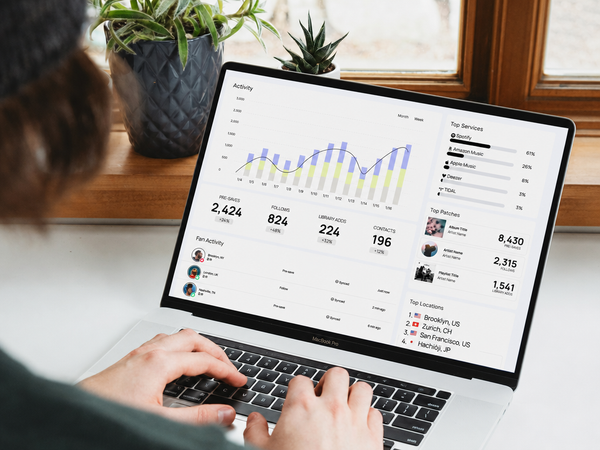
That distinction matters. Aggregate streaming metrics can tell you that a campaign generated activity. Fan-level data can help you determine who engaged and what relevant action to take next.
With its Shopify integration, Sonikit can sync customers, use shared contact information to connect Shopify customers with known streaming fans, and make that information available for audience segmentation and marketing.
How to segment fans using merch and streaming data
Audience segmentation divides fans into groups based on shared attributes or behavior.
Rather than promoting every product to an entire list, artists can build segments around the relationship between purchases and music engagement.
Here are several practical examples.
| Audience segment | Example criteria | Potential campaign |
|---|---|---|
| Engaged non-buyers | Pre-saved or followed, but never purchased | Introduce merchandise connected to the release |
| Customers who missed a release | Purchased previously, but did not pre-save the new release | Invite customers to hear or save the new music |
| Release supporters | Pre-saved the album and purchased related merch | Offer early access or an exclusive |
| Product-specific customers | Purchased a particular shirt, vinyl edition, or bundle | Promote a related or complementary product |
| Local customers | Purchased merch and lives near an upcoming tour market | Promote a show, pop-up, or local offer |
| Repeat customers | Completed multiple purchases | Create a VIP or loyalty audience |
| Lapsed customers | Purchased previously but not recently | Reintroduce the artist’s latest campaign |
| Streaming superfans | Completed several streaming actions but never purchased | Introduce a first-purchase offer |
| Non-buyers | Has not purchased a specific product | Promote that product without messaging existing buyers |
| Cross-channel fans | Purchased, pre-saved, followed, and opted in | Prioritize for special fan experiences |
These segments are more useful than a broad label such as “all fans” or “all customers.” Each one suggests a different message and objective.
Use negative conditions as well as positive ones
Some of the most valuable segments are based on what a fan has not done.
Examples include:
- Fans who pre-saved but did not purchase the related vinyl
- Fans who follow the artist but have never purchased merch
- Customers who bought one product but not its companion product
- Local fans who have not purchased tickets or a tour item
- Previous buyers who have not engaged with the newest release
Negative conditions help artists identify the next logical action while avoiding redundant promotions.
If someone already bought the limited-edition record, continuing to send that person repeated sales messages for the same record creates a poor experience. Excluding existing purchasers protects the relationship and gives the campaign a more relevant purpose.
Match merchandise to the fan’s level of engagement
Not every fan is ready for the same offer.
A useful strategy is to match the campaign to the fan’s demonstrated relationship with the artist.
New or lightly engaged fans
These fans may have visited a landing page, clicked a link, or discovered the artist recently.
Focus on:
- Introducing the story behind the product
- Connecting the merchandise to the music
- Inviting an email or SMS opt-in
- Featuring accessible products rather than high-priced bundles
- Building familiarity before applying urgency
Active streaming fans
These fans may have pre-saved, followed, or saved music.
Focus on:
- Products tied to the release they supported
- Limited editions based on the song, album, or visual campaign
- Bundles that deepen participation in the release
- Merch offers presented after a meaningful streaming action
First-time customers
A first purchase is the beginning of a customer relationship, not the end of a conversion funnel.
Focus on:
- A timely thank-you message
- Relevant information about the associated music
- Customer-only access or updates
- Related products rather than immediate repetition
- Opportunities to follow or save the artist on streaming
Repeat customers and highly engaged fans
These fans may have purchased multiple products and completed several music-related actions.
Focus on:
- Early access
- Limited or numbered editions
- Signed items
- VIP experiences
- Anniversary products
- Fan feedback or product input
- Recognition and exclusivity
The objective is not to assign a permanent value to each person. Fan behavior changes. Dynamic segments should update as people purchase, follow, pre-save, or interact with new campaigns.
Sell merch alongside music on landing pages
A music landing page should not force fans to choose between discovering a release and visiting a separate merchandise campaign.
Products can be presented alongside:
- Pre-save actions
- Streaming links
- Music players
- Videos
- Email or SMS forms
- Tour dates
- Social actions
- Release information
This creates a connected campaign experience.
For example, an album landing page might include:
- Album artwork and release information
- Spotify, Apple Music, and other streaming actions
- A featured vinyl edition
- A small collection of album merchandise
- Tour dates
- An email or SMS sign-up
The products should be relevant to that campaign rather than selected only because they are the newest items in the store.
Keep product information synchronized
Manually recreating ecommerce products on a landing page introduces unnecessary work and the risk of stale information.
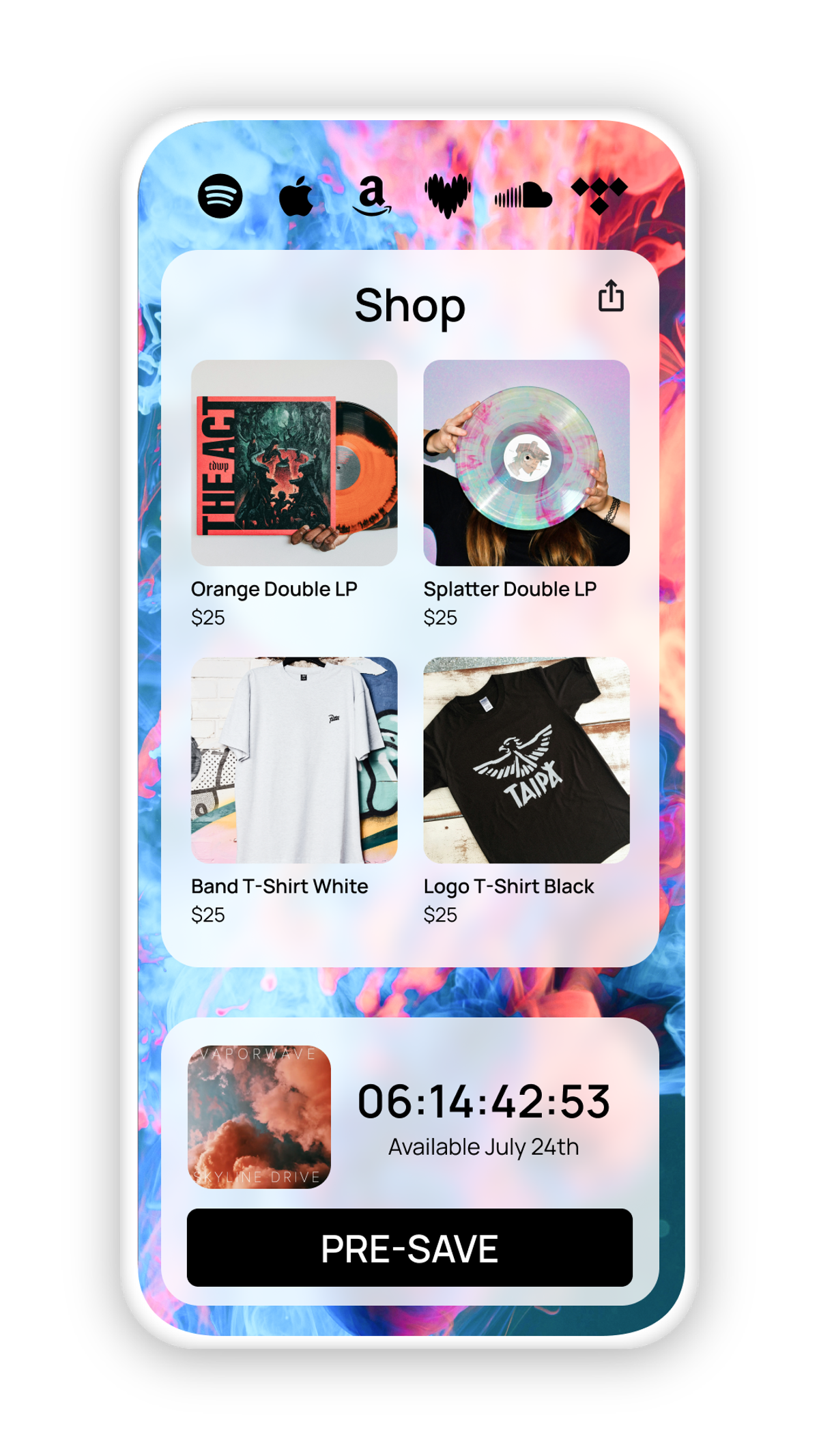
A connected Shopify product section can use current store data, including product images and other product details, while still allowing the artist or marketer to control how products are arranged on the landing page.
Sonikit allows artists and labels to select Shopify products, arrange their display order, and add a customizable product section to a music landing page. Fans can discover merchandise without needing to search through the entire storefront.
Learn more about music merch marketing with Sonikit.
Connect merch campaigns to music release campaigns
Merchandise performs best when it has a clear reason to be relevant now.
A release campaign naturally creates that reason.
Before the release
Use the pre-release period to:
- Introduce the visual identity of the release
- Preview upcoming products
- Collect email or SMS subscribers
- Build a pre-save audience
- Give existing customers early access
- Identify fans engaging with the campaign
During the release window
When the music becomes available:
- Feature the release and its merchandise on the same landing page
- Promote products to fans who pre-saved
- Exclude fans who already purchased
- Introduce vinyl, physical editions, or release bundles
- Connect customer campaigns back to the music
- Coordinate email, SMS, social, and paid promotion
After the initial release
After release week:
- Follow up with customers
- Promote related products to engaged non-buyers
- Re-engage previous customers
- Build audiences based on the campaign’s results
- Introduce tour or anniversary merchandise later
- Continue directing purchasers toward the music
This approach gives merchandise a role throughout the release lifecycle instead of treating it as a single announcement.
Use automation to respond at the right moment
Marketing automation uses a trigger or fan action to begin a predefined sequence.
For music merch marketing, useful triggers can come from either side of the fan relationship:
- A fan makes a purchase
- A fan pre-saves a release
- A fan follows the artist
- A fan saves music
- A fan opts in to email or SMS
- A fan enters a particular audience segment
The automation can then perform one or more actions.
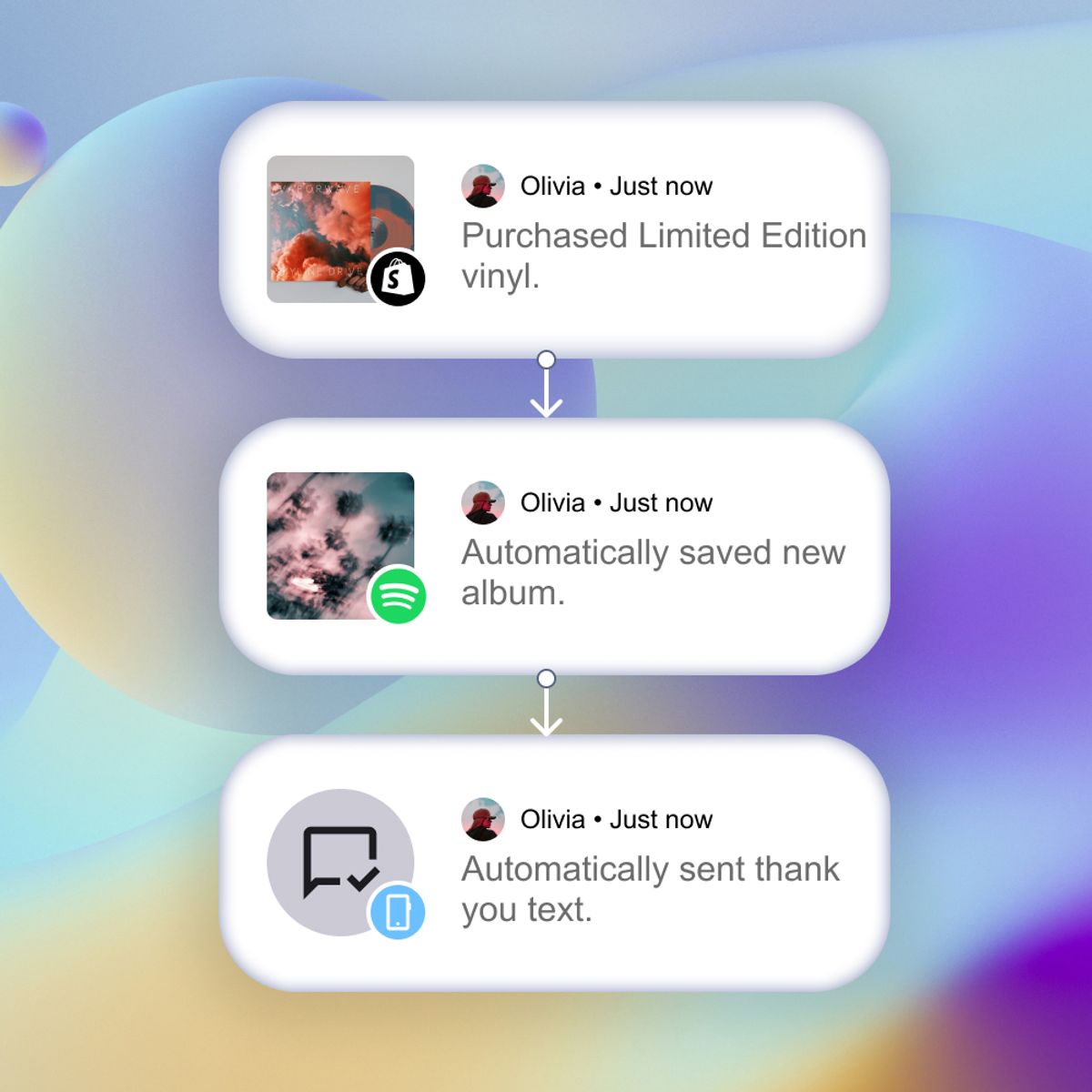
Automation example: thank a customer after a purchase
Trigger: A Shopify purchase is completed
Actions: Send a thank-you message and add the customer to a purchaser segment
The message can also introduce the music connected to the product, provide relevant order context, or invite the customer into a broader fan community.
Automation example: promote merch after a pre-save
Trigger: A fan pre-saves an upcoming album
Condition: The fan has not purchased the related product
Action: Send a message featuring the album’s vinyl edition or merchandise
The pre-save establishes interest in the release. The purchase-history condition prevents the message from being sent to someone who already bought the product.
Automation example: convert customers into streaming fans
Trigger: A customer purchases release merchandise
Condition: The customer has not completed the desired streaming action
Action: Invite the customer to follow the artist or save the release
This reverses the usual funnel. Rather than moving listeners toward merchandise, it moves customers toward deeper music engagement.
Automation example: create a high-value fan segment
Trigger: A fan completes a qualifying purchase or streaming action
Conditions: The fan has purchased and completed one or more music actions
Action: Add the fan to a high-engagement or VIP segment
That segment can be used later for early access, special editions, invitations, or direct fan research.
The central principle is simple: automation should respond to meaningful behavior. It should not merely increase the number of messages a fan receives.
Choose the right channels for merch promotion
A complete strategy can use several channels, but each should have a distinct role.
Email works well for:
- Product storytelling
- Merch-drop announcements
- Multiple product images
- Release and merchandise bundles
- Early-access campaigns
- Post-purchase communication
- Longer explanations of product meaning or production
Segment email campaigns so customers, non-customers, and highly engaged fans do not always receive identical messages.
SMS
SMS is effective for concise, time-sensitive communication such as:
- A limited product going live
- Early access beginning
- Low-stock reminders
- A local pop-up or tour item
- A customer-only release
- A short post-purchase thank-you
Use SMS selectively. The immediacy that makes it valuable also makes irrelevant messages more intrusive.
Music landing pages
Landing pages provide a campaign destination where music, products, videos, tour dates, and opt-ins can work together.
Use a focused selection of products rather than attempting to reproduce the entire store.
Social media
Social platforms are useful for:
- Showing products in context
- Sharing creative development
- Featuring fans wearing merchandise
- Announcing drops
- Demonstrating packaging or physical details
- Directing fans to the campaign landing page
Social reach is useful, but it should feed an audience that the artist can recognize and contact directly.
Paid advertising
Advertising can extend a campaign beyond existing email and SMS audiences. Retargeting can be especially useful for reaching people who visited a campaign or engaged with relevant content.
Where applicable, use customer and fan segments thoughtfully, follow platform requirements, and ensure that tracking and consent practices match the regions in which the campaign operates.
How to market merch without spamming fans
More messages do not automatically create more sales. Relevance, timing, and restraint matter.
Use these principles:
1. Exclude people who already converted
If the campaign promotes a specific item, exclude fans who already purchased it unless the message provides genuinely useful customer information.
2. Use behavior to establish relevance
A vinyl promotion is more relevant when the recipient has already pre-saved, followed, or engaged with the corresponding release.
3. Limit overlapping campaigns
A fan might belong to several segments simultaneously. Establish rules so one highly engaged person does not receive multiple versions of the same promotion.
4. Vary the message by relationship
A repeat customer should receive recognition. A new listener may need more context. An active streaming fan may respond to the product’s connection with the music.
5. Balance promotional and fan-focused communication
Share creative context, stories, music, access, and appreciation—not only purchase requests.
6. Make frequency part of the strategy
Consider how often each channel is used and whether the campaign is important enough to justify the interruption.
Good segmentation is not just a conversion tool. It is a way to protect fan trust.
Music merch marketing ideas artists and labels can use
Here are practical campaign ideas that connect products with fan behavior.
Offer release merch to fans who pre-saved
Create an audience of fans who pre-saved the release but have not purchased the associated merchandise. Send a focused campaign explaining how the product connects to the release.
Give previous customers early access
Reward existing customers with advance access to a new merch drop. For label campaigns, this can be scoped to customers of the relevant artist or product line.
Promote vinyl to highly engaged streaming fans
Identify fans who followed, pre-saved, or saved the release but have not purchased its physical edition.
Re-engage customers with new music
A previous customer may be highly valuable even if they have not participated in the current campaign. Introduce the new release before immediately promoting another product.
Build city-specific audiences
Combine customer or streaming activity with location to promote:
- Tour dates
- Pop-up shops
- Local pickup
- City-specific products
- Regional events
Cross-sell related products
Create a segment of people who purchased one product but not a complementary item. Ensure the relationship between the products is obvious and useful.
Create a multi-channel superfan audience
Combine purchase history with pre-saves, follows, saves, or direct opt-ins. Use this audience for early access and exclusive opportunities—not simply a higher volume of sales messages.
Add merch to evergreen music pages
Merchandise does not have to disappear when a launch ends. Add selected products to artist hubs, link-in-bio pages, catalog campaigns, and long-running release pages.
How labels can apply this strategy across multiple artists
Labels face an additional challenge: ecommerce and engagement may be distributed across several artists, stores, projects, and campaigns.
A label-level strategy should preserve artist context while enabling consistent processes.
Labels can:
- Connect relevant Shopify stores
- Build artist-specific customer segments
- Create reusable campaign templates
- Identify cross-channel engagement for each artist
- Standardize post-purchase workflows
- Coordinate merch and release calendars
- Compare audience behavior across campaigns
- Give individual teams access to the appropriate data and workflows
Avoid treating every customer in a label database as equally interested in every artist. Purchase and engagement history should determine which campaigns are relevant.
Shared infrastructure should produce better targeting—not broader, less personal messaging.
What metrics should you track?
Revenue is important, but it is not the only measure of a successful campaign.
Track metrics across the fan journey.
Commerce metrics
- Orders
- Revenue
- Average order value
- Units sold
- Conversion rate
- Repeat purchase rate
- Revenue by product
- Revenue by campaign
- Time between purchases
Audience metrics
- New identified fans
- New email or SMS subscribers
- Customers matched with known fans
- Growth of high-value segments
- Engaged non-buyers
- Repeat customers
- Segment movement over time
Music engagement metrics
- Pre-saves
- Follows
- Saves
- Streaming-service actions
- Engagement by customer segment
- Customer participation in release campaigns
Campaign metrics
- Landing-page visits
- Product clicks
- Email clicks
- SMS clicks
- Conversion by audience segment
- Purchases after streaming actions
- Streaming actions after purchases
The most revealing questions often cross categories:
- Are customers also engaging with new releases?
- Which streaming actions are most common among purchasers?
- Which audience segments convert most often?
- Are previous customers more responsive than general subscribers?
- Which products attract new buyers?
- Which campaigns create both purchases and music engagement?
These questions help artists understand the relationship between revenue and fandom.
Common music merch marketing mistakes
Treating the entire audience the same
A general announcement may be appropriate for a major launch, but every follow-up should not go to every fan.
Separating merch from the music
A product is more meaningful when fans understand its connection to an artist, release, visual identity, tour, or moment.
Promoting only through social media
Social platforms are valuable discovery channels, but reach can be unpredictable. Use campaigns to build direct, permission-based fan relationships as well.
Sending the same promotion to existing buyers
This wastes attention and can make customers feel unrecognized. Use purchase-history exclusions whenever possible.
Hiding merch in a separate store experience
Fans should be able to discover relevant products during the music campaign, even if checkout ultimately occurs in the ecommerce store.
Automating without meaningful conditions
A trigger alone does not make a message relevant. Combine triggers with purchase, engagement, location, timing, or segment conditions.
Measuring streams and sales separately
Separate totals cannot reveal how streaming fans become customers or how customers continue engaging with the music.
How Sonikit connects Shopify, music marketing, and fan data
Sonikit is a music marketing platform for artists, labels, and marketers. Its Shopify integration connects ecommerce activity with Sonikit’s landing pages, audience tools, music integrations, messaging, and Action Flow automations.
Artists and labels can use the integration to:
- Display selected Shopify products on customizable music landing pages
- Keep product images and information connected to Shopify
- Sync Shopify customers with Sonikit
- Match customers with known streaming fans using shared contact information
- Build dynamic segments based on purchase history
- Combine purchases with pre-saves, follows, location, and other fan data
- Trigger automations when purchases occur
- Promote merch after fans complete streaming actions
- Send more relevant email and SMS campaigns
- Exclude existing purchasers from product promotions
- Identify fans who engage across both streaming and ecommerce
Instead of treating a Shopify customer and a streaming fan as unrelated records, Sonikit helps marketers understand when those activities belong to the same fan and use that context in future campaigns.
Explore music merch marketing with Sonikit or learn more about the Shopify integration.
A simple music merch marketing plan
Artists and labels can use this framework to begin connecting merch with the rest of their marketing.
Step 1: Define the campaign objective
Decide whether the primary goal is to:
- Sell a specific product
- Support a new release
- Reward existing customers
- Convert streaming fans into buyers
- Re-engage previous customers
- Identify high-value fans
- Grow direct fan relationships
Step 2: Connect your commerce and marketing tools
Connect Shopify with the platform used to manage landing pages, audience data, streaming actions, email, SMS, and automation.
Step 3: Choose the relevant products
Select products that clearly relate to the release, tour, audience, or campaign moment.
Step 4: Build the campaign destination
Create a landing page that combines the product with the relevant music, video, tour date, or fan action.
Step 5: Define the audience
Use purchase history, streaming engagement, location, and opt-in status to determine who should—and should not—receive the campaign.
Step 6: Coordinate your channels
Decide what role email, SMS, social media, landing pages, and advertising will play.
Step 7: Add behavioral follow-up
Use automation to respond to purchases, pre-saves, follows, saves, and segment changes.
Step 8: Measure the complete fan journey
Evaluate purchases and music engagement together. Use what you learn to improve the next campaign.
Final takeaway
The best music merch marketing does more than place products in front of fans. It connects each product to the music, moment, and audience most likely to find it meaningful.
That requires artists and labels to move beyond disconnected store, streaming, and messaging data.
When Shopify purchases and streaming engagement become part of the same fan strategy, marketers can:
- Recognize customers who also engage with the music
- Find active listeners who have never purchased
- Build more precise audience segments
- Avoid sending irrelevant offers
- Respond automatically to meaningful fan actions
- Promote merchandise throughout the release lifecycle
- Develop stronger long-term fan relationships
Merch and music are not separate sides of an artist’s business. They are different expressions of the same fan relationship.
Connect Shopify with Sonikit to bring merchandise, streaming engagement, audience segmentation, landing pages, and automation into one music marketing platform.
Frequently asked questions about music merch marketing
What is the best way to market music merchandise?
The best approach is to connect merchandise to a relevant artist moment—such as a release, tour, anniversary, or fan milestone—and promote it to a defined audience. Use purchase history and music engagement to distinguish existing customers, active listeners, new fans, and non-buyers.
How can musicians sell more merchandise?
Musicians can sell more merchandise by improving product relevance, placing merch alongside music, segmenting fans by behavior, promoting products at meaningful moments, following up across email and SMS, and excluding people who already purchased the promoted item.
How can artists promote merch without annoying fans?
Artists can reduce irrelevant promotion by segmenting their audience, limiting campaign frequency, excluding existing buyers, and matching offers to demonstrated fan interests. Messages should also provide music, stories, access, or appreciation—not only repeated sales requests.
Should artists use Shopify to sell merchandise?
Shopify is a popular ecommerce platform for managing products, inventory, customer orders, and checkout. It can also connect with music platforms and marketing tools. The best choice depends on an artist’s catalog, fulfillment needs, budget, and desired integrations.
Can artists sell Shopify products from a music landing page?
Artists can display Shopify products on a connected music landing page when their landing-page platform supports a Shopify integration. With Sonikit, selected Shopify products can appear alongside streaming, pre-save, video, tour, and fan opt-in content.
How can artists connect Shopify customers with streaming fans?
A music marketing platform can use shared identifying information to match eligible Shopify customers with recognized fan profiles and streaming activity. Sonikit uses this approach to help artists understand when a customer has also pre-saved, followed, saved music, or completed other known fan actions.
What are useful music merch audience segments?
Useful segments include streaming fans who have never purchased, customers who did not engage with a new release, purchasers of a specific product, repeat customers, local buyers, lapsed customers, and fans who have completed both purchase and streaming actions.
What music merch marketing tasks can be automated?
Artists can automate post-purchase thank-you messages, customer segmentation, merch promotion after streaming actions, exclusion of existing buyers, customer re-engagement, and movement into VIP or high-engagement audiences.
How does merchandise fit into an album release campaign?
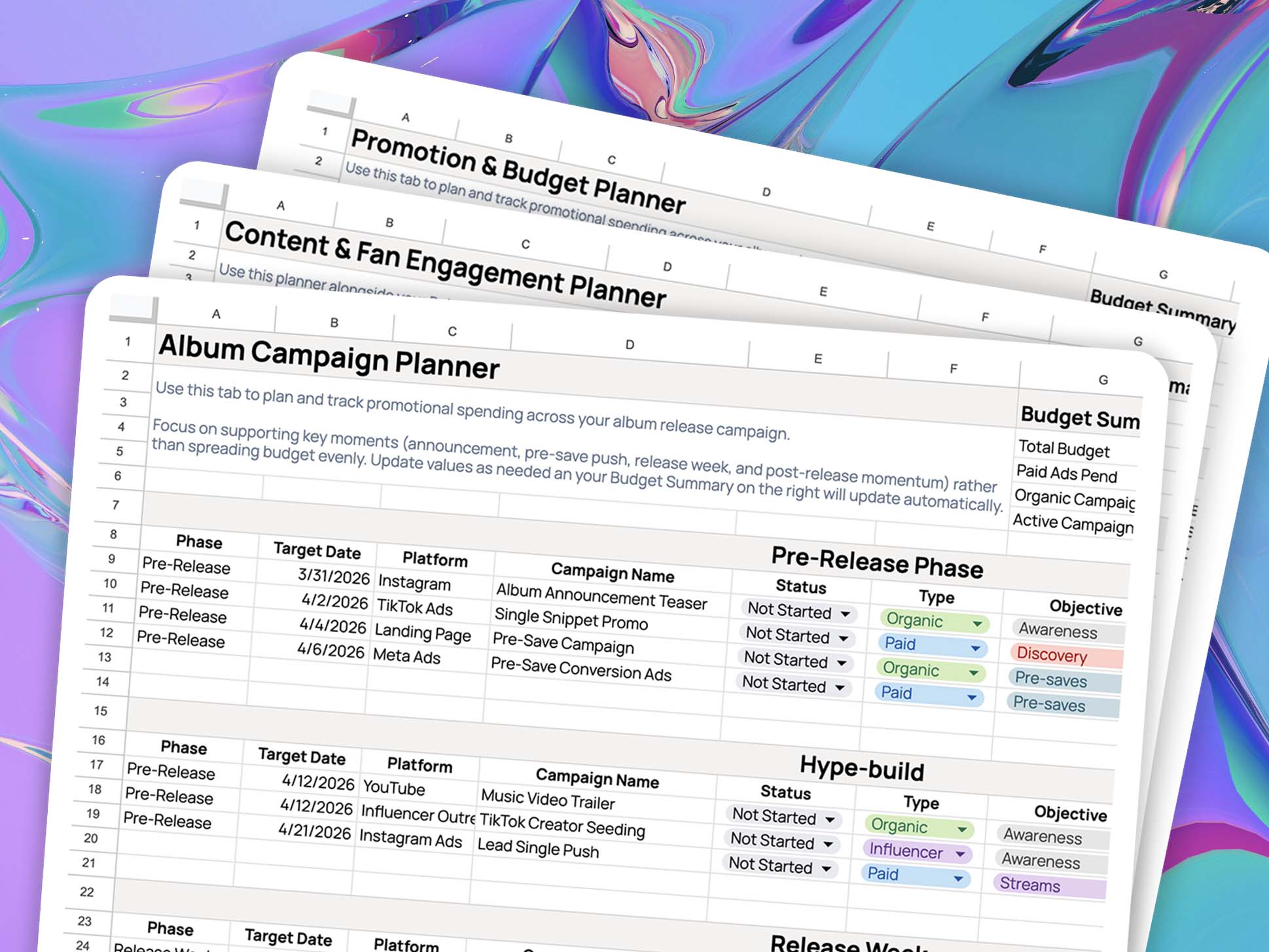
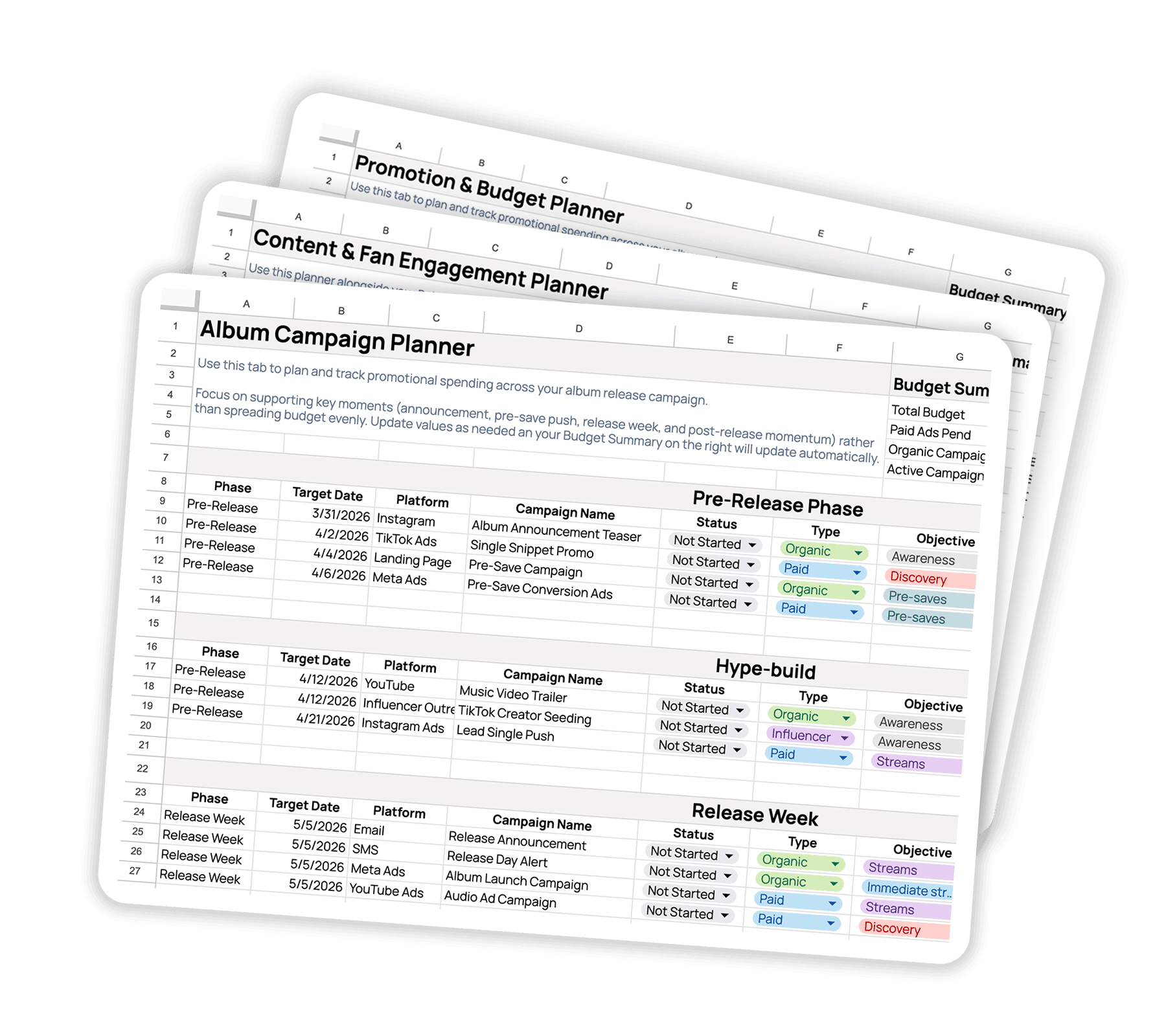
Merchandise can support an album campaign before, during, and after release. Artists can preview products during the pre-save period, feature them on the release landing page, promote them to engaged non-buyers, thank customers after purchase, and reconnect purchasers with the music.
How should labels market merchandise across multiple artists?
Labels should maintain artist-specific customer and engagement segments, create reusable campaign workflows, and use fan behavior to determine relevance. A customer of one artist should not automatically receive merchandise campaigns for every artist on the label.

Keep reading
All posts
How to Build a 3-Step Action Flow: SMS Sign-Up to Pre-Save and Follow

New Project or New Landing Page? How to Structure Sonikit for Multiple Releases, Artists, or Tours