12 Music Merch Marketing Ideas to Sell More Without Spamming Fans
The best music merch marketing does not promote every product to every fan. It uses context—such as purchase history, streaming engagement, location, and campaign activity—to determine which offer is relevant to each audience.
That distinction matters because fans do not all have the same relationship with an artist.
One fan may have just discovered a single. Another may have pre-saved the upcoming album. A third may already own its vinyl edition. Someone else may have purchased several times but missed the newest release entirely.
Sending the same merch message to all four people ignores what they have already done.
A better strategy connects ecommerce and streaming activity so artists and labels can:
- Promote products related to a fan’s interests
- Exclude people who already purchased
- Recognize repeat customers
- Connect merch campaigns to releases
- Respond to meaningful fan actions
- Use email and SMS more selectively
- Move fans between listening and purchasing
Here are 12 music merch marketing ideas designed to generate sales while protecting fan attention and trust.
1. Promote release merch to fans who pre-saved
A pre-save is a strong indication that a fan is interested in a particular release. That makes the pre-save audience a natural place to introduce related merchandise.
Instead of promoting the artist’s entire store, feature products tied directly to the music the fan supported:
- Vinyl or another physical edition
- Release-specific apparel
- Posters
- Signed products
- Limited bundles
- Collectible editions
Audience: Fans who pre-saved a specific release but have not purchased its associated merchandise.
Message: Connect the product to the release rather than sending a general store announcement.
You’ve already saved the album. Explore the vinyl edition and collection inspired by the release.
Channel: Email works well when the product requires images or storytelling. SMS can support a limited drop or deadline-sensitive offer.
Timing: Shortly after the pre-save, when the fan’s interest is fresh, or closer to release day when anticipation is highest.
Build it with Sonikit: Use the pre-save action as an Action Flow trigger, add a purchase-history condition, and send the relevant merch link only to fans who have not purchased the product.
2. Introduce merch to engaged streaming fans who have never purchased
Some of an artist’s most engaged listeners may never have visited the merch store.
A fan who follows the artist, saves music, or participates in release campaigns has already demonstrated interest. Instead of treating them like a completely cold ecommerce audience, introduce merchandise as another way to participate in the artist’s world.
Start with a focused selection. A first-time buyer may respond better to one accessible, relevant product than an overwhelming catalog or expensive bundle.
Audience: Fans who completed one or more streaming actions but have no purchase history.
Message: Explain the connection between the merchandise and the music.
If this release has been in your rotation, here’s the collection created alongside it.
Channel: Email, an Action Flow message, or a product section placed directly on the release landing page.
Timing: After the fan completes a meaningful streaming action or during an active release campaign.
Build it with Sonikit: Create a dynamic segment that combines streaming engagement with the condition that the fan has not purchased any product. Use the segment for a focused email or SMS campaign.
3. Stop promoting a product after someone buys it
One of the easiest ways to improve merch marketing is to stop asking customers to purchase something they already own.
If a fan buys the vinyl edition on the first day of a campaign, they should not continue receiving reminders to purchase it throughout the week.
Instead, move that fan into a different experience:
- Thank them
- Share relevant product or release updates
- Introduce the music
- Recommend a genuinely complementary product
- Give them early access to something else
- Exclude them from the remaining sales sequence
Audience: Customers who purchased the product currently being promoted.
Message: Recognition rather than repetition.
Thanks for supporting the new album. Here’s what’s coming next in the release campaign.
Channel: Email or SMS, depending on the customer’s consent and the importance of the update.
Timing: Immediately after purchase or before the next scheduled promotional message.
Build it with Sonikit: Use purchase data to remove buyers from the non-purchaser segment or apply a “did not purchase this product” condition to every promotional audience.
4. Send a useful post-purchase thank-you
An order confirmation is transactional. A direct message from the artist can deepen the fan relationship.
A post-purchase thank-you should not immediately push another sale. Use it to acknowledge the support and help the customer connect more deeply with the music or campaign behind the product.
The message might include:
- A personal thank-you
- A note about the product’s meaning
- A link to the related release
- A behind-the-scenes video
- Care or sizing information
- Details about when a preorder will ship
- An invitation to follow or save the artist
Audience: Fans who completed a purchase.
Message: Appreciation first, with one relevant next action.
Thanks for supporting the new record. While you wait for the vinyl, you can save the album here so it’s ready in your library.
Channel: Email is appropriate for a detailed message. SMS works for a short thank-you when the fan has explicitly opted in.
Timing: Soon after the purchase, while the customer’s interest is high.
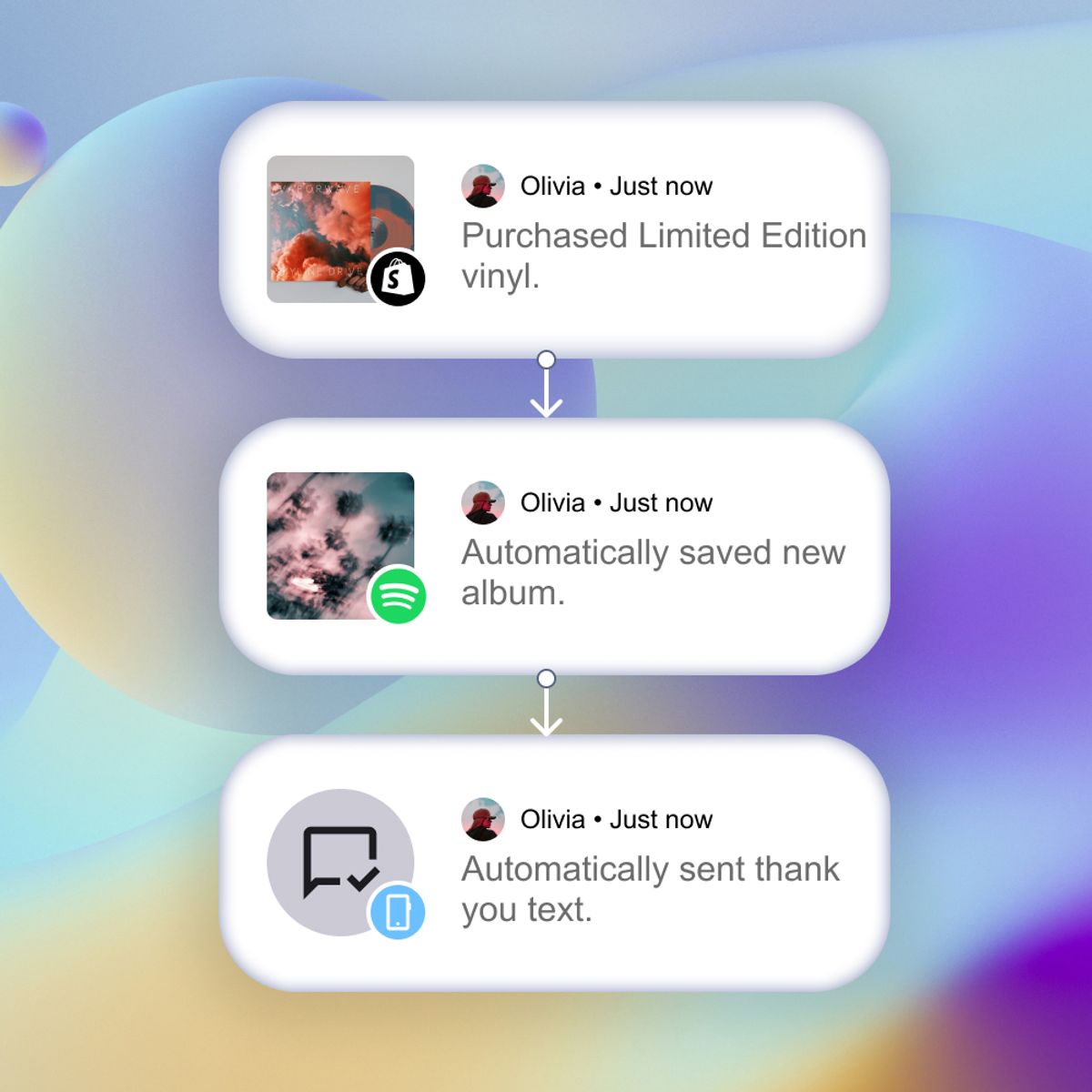
Build it with Sonikit: Use a Shopify purchase event to begin an Action Flow, send the appropriate thank-you, and add the fan to a customer or product-specific segment.
5. Reconnect previous customers with new music
Merch marketing should not always move from streaming to a purchase. It can also move customers back toward the music.
Someone who purchased from an artist in the past has demonstrated support, but they may not know about the latest single or album. Instead of opening with another product pitch, introduce the new release.
This approach is particularly useful for:
- Previous vinyl customers
- Tour merch buyers
- Anniversary product customers
- Customers who purchased during an older album cycle
- Buyers with no recent streaming engagement
Audience: Previous customers who have not pre-saved, followed, or otherwise engaged with the newest release.
Message: Lead with the new music.
You supported the last release. Here’s the first song from what we’ve been creating next.
Channel: Email, SMS, or a campaign landing page combining the music and selected products.
Timing: At the beginning of a release campaign, before repeated merch promotion begins.
Build it with Sonikit: Create a segment that combines past purchase history with the absence of a current release action. Send an SMS campaign to the audience with a link to a landing page where they can hear, follow, or pre-save the release.
6. Give existing customers early access to a merch drop
Early access rewards previous support while helping artists generate initial momentum.
The offer does not necessarily require a discount. For limited products, being able to shop before the general public may be valuable on its own.
Early-access audiences could include:
- Anyone who purchased previously
- Customers of a related product
- Repeat customers
- Fans who purchased and pre-saved
- Customers above a defined order value
- Supporters active across several campaigns
Audience: A qualified customer or high-engagement segment.
Message: Make the reason for access clear.
You supported the last release, so you can shop the new collection before it opens to everyone else.
Channel: Email for the complete product presentation, supported by SMS when access opens.
Timing: Several hours or a day before the public launch.
Build it with Sonikit: Build a segment using purchase history and optional streaming conditions. Send an SMS campaign to the group with a link to a dedicated Sonikit landing page featuring the early-access products.
7. Cross-sell products that have a meaningful connection
Cross-selling works best when the relationship between products is obvious.
A customer who purchased an album shirt might be interested in the vinyl edition. Someone who purchased standard vinyl might want a related signed poster. A buyer of one item in a collection may be interested in the companion product.
Avoid promoting unrelated merchandise simply because a purchase occurred.
Audience: Customers who purchased Product A but did not purchase Product B.
Message: Explain why the second product belongs with the first.
Complete the album collection with the limited poster created from the original cover artwork.
Channel: Email or a selective post-purchase flow.
Timing: After the initial purchase has been acknowledged, or when the related product becomes available.
Build it with Sonikit: Create a segment using both a positive purchase condition and a negative one: purchased Product A and did not purchase Product B.
8. Promote merch by city before a show or tour date
Location can make a merch campaign significantly more relevant.
Before an upcoming show, artists can create an audience of known fans or customers in the surrounding market and promote:
- A tour-exclusive product
- A local pop-up
- Venue pickup
- A city-specific poster
- A limited product available at the show
- A nearby listening event
- The show itself
Combining location with streaming or purchase behavior makes the audience more precise than a general geographic send.
Audience: Fans in a particular city or region who have purchased, followed, pre-saved, or otherwise engaged.
Message: Lead with local relevance.
We’ll be in Chicago next week. Preview the tour collection and see what will be available at the show.
Channel: Email, SMS, or a localized landing page.
Timing: Several days before the event, with a selective reminder closer to the date if appropriate.
Build it with Sonikit: Combine location with purchase or streaming conditions in the segment builder. Direct the audience to a page containing the relevant tour date, music, and products.
9. Add relevant products to every release landing page
Merchandise should be discoverable where fans are already engaging with the music.
A release landing page can place selected products alongside:
- Pre-save actions
- Streaming links
- Videos
- Release information
- Email or SMS forms
- Tour dates
- Social actions
This does not mean reproducing the entire store. Feature a small number of products that make sense for that specific page.
For an album campaign, that might include the vinyl edition, one shirt, and a signed bundle. For a tour page, it might include the current tour collection.
Audience: Everyone visiting the release or campaign page.
Message: Let placement create the connection. The products should visually and conceptually belong to the campaign.
Channel: Music landing page.
Timing: Throughout the campaign, from pre-release through the catalog phase.
Build it with Sonikit: Connect Shopify, add a Product List element to the landing page, select the relevant products, choose a column, grid, or slider layout, and arrange the display order. Product images and information come from the connected Shopify store.
10. Reward fans who engage across streaming and ecommerce
A high-value fan should not be defined by spending alone.
Some of the strongest supporters participate in several ways. They might purchase, pre-save, follow, join the SMS list, and return for multiple campaigns.
Build a segment around that combined engagement and use it for experiences that recognize the relationship:
- Early access
- Signed products
- Limited editions
- Private livestreams
- Listening sessions
- Fan surveys
- Product feedback
- VIP opportunities
- Anniversary campaigns
Audience: Fans who meet a combination of purchase and engagement conditions.
Message: Recognition should be central.
You’ve supported the music in more ways than one. We wanted you to see this first.
Channel: Email or SMS, depending on the nature and urgency of the opportunity.
Timing: Reserve this audience for moments that are genuinely special.
Build it with Sonikit: Combine purchase history with pre-saves, follows, location, opt-in status, or other fan activity to create a dynamic high-engagement segment.
11. Re-engage past customers with a relevant new release or product
A previous customer remains valuable even if they have not purchased recently. But a re-engagement campaign should offer a real reason to return.
Useful reasons include:
- A new release
- A related product
- An anniversary edition
- A restock
- A new format of something they previously purchased
- A tour connected to their location
- A new collection from the same visual era
Avoid using vague messages such as “We miss you” when the artist has something more meaningful to share.
Audience: Previous customers without a recent purchase or music action.
Message: Lead with what has changed since their last interaction.
Since you supported the last album, we’ve released new music and created a collection around its artwork.
Channel: Email is generally best because it provides room to rebuild context.
Timing: During a relevant release, restock, anniversary, or tour moment—not merely because a certain number of days has passed.
Build it with Sonikit: Create a segment using earlier purchase history and the absence of recent engagement. Send a text to the audience with a focused campaign page rather than the general store homepage.
12. Coordinate merch, music, and messaging as one campaign
The strongest merch campaigns do not treat the product launch, music release, landing page, email, SMS, and streaming actions as separate projects.
Build one connected fan journey.
For example:
- A fan visits an album landing page
- The fan pre-saves the release
- An Action Flow checks whether they purchased the vinyl
- Eligible non-buyers receive a message featuring the physical edition
- Customers are excluded from additional vinyl promotions
- Purchasers receive a thank-you and a relevant streaming action
- Fans who purchase and engage with the music enter a high-engagement segment
Each step responds to what the fan has already done.
Audience: Multiple segments participating in the same release or merch campaign.
Message: Adapt the message by stage instead of repeating one announcement.
Channel: Landing pages, email, SMS, streaming actions, and Shopify.
Timing: Across the full campaign lifecycle—from pre-release through post-purchase follow-up.
Build it with Sonikit: Use a Sonikit landing page as the campaign destination, Shopify for product and customer data, dynamic segments for audience logic, and Action Flows to respond to purchase or streaming activity.
A simple framework for better merch campaigns
Before sending a merch promotion, answer five questions:
Who should receive it?
Define the audience using purchase history, streaming engagement, location, and consent—not only a general mailing list.
Why is the product relevant?
Connect the product to music, a release, a tour, a previous purchase, or another meaningful fan action.
Who should be excluded?
Remove fans who already purchased or completed the campaign’s desired action.
Why should the message be sent now?
Use a genuine moment such as a release, drop, event, restock, anniversary, or recent fan interaction.
What should happen after the fan responds?
Plan the next experience for both purchasers and non-purchasers. Do not let every path lead back to the same repeated sales message.
How Sonikit supports music merch marketing
Sonikit connects music marketing with ecommerce so artists and labels can treat listeners and customers as part of the same audience.
With Sonikit, marketers can:
- Display selected Shopify products on customizable music landing pages
- Sync Shopify customer and purchase data
- Match eligible Shopify customers with known streaming fans
- Build segments based on purchases of any or specific products
- Combine purchase history with pre-saves, follows, location, and other fan data
- Identify purchasers and non-purchasers
- Trigger Action Flows from purchase or streaming activity
- Send merch links after fans complete relevant music actions
- Exclude existing buyers from repeated promotions
- Recognize fans who engage across several channels
This makes merch marketing more precise without requiring artists to separate their release, customer, and audience strategies.
Explore music merch marketing with Sonikit or learn more about Sonikit’s Shopify integration.
Final takeaway
Selling more merchandise does not require sending more promotions to every fan.
It requires understanding:
- What the fan is interested in
- Which actions they have already completed
- What they have purchased
- How recently they engaged
- Which message is relevant now
- When no message is needed
Connected streaming and purchase data helps artists move beyond one-size-fits-all merch campaigns. Pre-save participants can discover products related to the release. Existing buyers can be excluded from repeated offers. Previous customers can be reconnected with new music. Highly engaged supporters can receive meaningful recognition.
The best music merch marketing feels like a natural continuation of the fan’s relationship with the artist—not an interruption of it.

Keep reading
All posts
How to Build a 3-Step Action Flow: SMS Sign-Up to Pre-Save and Follow

New Project or New Landing Page? How to Structure Sonikit for Multiple Releases, Artists, or Tours